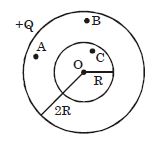
A hollow conducting sphere of inner radius $R$ and outer radius $2R$ is given a charge $Q$ as shown in the figure, then the :
Easy


Download our appand get started for free
Experience the future of education. Simply download our apps or reach out to us for more information. Let's shape the future of learning together!No signup needed.*
Similar Questions
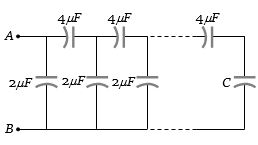
- 1A finite ladder is constructed by connecting several sections of $2\,\mu F,\;4\,\mu F$ capacitor combinations as shown in the figure. It is terminated by a capacitor of capacitance $C$. What value should be chosen for $C$ such that the equivalent capacitance of the ladder between the points $A$ and $B$ becomes independent of the number of sections in between......$\mu F$View Solution
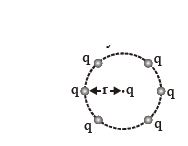
- 2A point charge is surrounded symmetrically by six identical charges at distance $r$ as shown in the figure. How much work is done by the forces of electrostatic repulsion when the point charge $q$ at the centre is removed at infinityView Solution
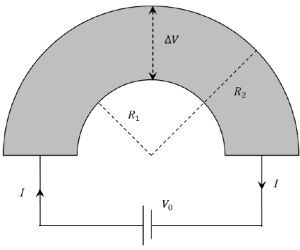
- 3Shown in the figure is a semicircular metallic strip that has thickness $t$ and resistivity $\rho$. Its inner radius is $R_1$ and outer radius is $R_2$. If a voltage $V_0$ is applied between its two ends, a current $I$ flows in it. In addition, it is observed that a transverse voltage $\Delta V$ develops between its inner and outer surfaces due to purely kinetic effects of moving electrons (ignore any role of the magnetic field due to the current). Then (figure is schematic and not drawn to scale)-View Solution
$(A)$ $I =\frac{V_0 t}{\pi \rho} \ln \left(\frac{R_2}{R_1}\right)$
$(B)$ the outer surface is at a higher voltage than the inner surface
$(C)$ the outer surface is at a lower voltage than the inner surface
$(D)$ $\Delta V \propto I ^2$
- 4The capacitor of capacitance $4\,\mu F$ and $6\,\mu F$ are connected in series. A potential difference of $500\;volts$ is applied to the outer plates of the two capacitor system. The potential difference across the plates of capacitor of $4\,\mu F$ capacitance is.........$volts$View Solution
- 5Two identical capacitors are joined in parallel, charged to a potential $V$ and then separated and then connected in series $i.e.$ the positive plate of one is connected to negative of the otherView Solution
- 6The capacity and the energy stored in a parallel plate condenser with air between its plates are respectively ${C_o}$ and ${W_o}$. If the air is replaced by glass (dielectric constant $= 5$ ) between the plates, the capacity of the plates and the energy stored in it will respectively beView Solution
- 7A parallel plate capacitor of capacitance $C$ is connected to a battery and is charged to a potential difference $V$. Another capacitor of capacitance $2C$ is similarly charged to a potential difference $2V$. The charging battery is now disconnected and the capacitors are connect in parallel to each other in such a way that the positive terminal of one is connected to the negative terminal of the other. The final energy of the configuration isView Solution
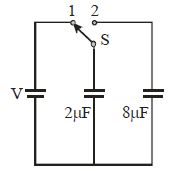
- 8A $2\,\mu F$ Capacitor is charged as shown in the figure. The percentage of its store energy dissipated after the switch $S$ is turned to position $2$, is.....$\%$View Solution
- 9At a certain distance from a point charge, the field intensity is $500\, Vm^{-1}$ and the potential is $-3000\, V$. The distance to the charge and the magnitude of the charge respectively areView Solution
- 10Two insulated metallic spheres of $3\,\mu F$ and $5\,\mu F$ capacitances are charged to $300\, V$ and $500\, V$ respectively. The energy loss, when they are connected by a wire isView Solution