Three capacitors of capacitances $3\,\mu F,\;9\,\mu F$ and $18\,\mu F$ are connected once in series and another time in parallel. The ratio of equivalent capacitance in the two cases $\left( {\frac{{{C_s}}}{{{C_p}}}} \right)$ will be
Medium


Download our appand get started for free
Experience the future of education. Simply download our apps or reach out to us for more information. Let's shape the future of learning together!No signup needed.*
Similar Questions
- 1Two capacitors each of $1\,\mu F$ capacitance are connected in parallel and are then charged by $200\;volts$ $d.c.$ supply. The total energy of their charges (in $joules$) isView Solution
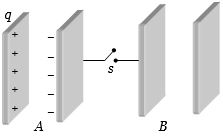
- 2Consider the situation shown in the figure. The capacitor $A$ has a charge $q$ on it whereas $B$ is uncharged. The charge appearing on the capacitor $B$ a long time after the switch is closed isView Solution
- 3View SolutionWhich of the following is possible application of an RC circuit?
- 4A capacitor of capacitance $C$ is charged to a potential difference $V_0$. The charging battery is removed and the capacitor is now connected to an uncharged capacitor of unknown capacity, the potential difference across the combination becomes $V$. The unknown capacitance isView Solution
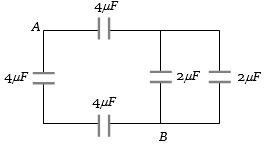
- 5In the circuit as shown in the figure the effective capacitance between $A$ and $B$ is........$\mu \,F$View Solution
- 6The energy of a charged capacitor is given by the expression ($q$= charge on the conductor and $C$ = its capacity)View Solution
- 7Three charges $-q, Q$ and $-q$ are placed respectively at equal distances on a straight line. If the potential energy of the system of three charges is zero, then what is the ratio of $Q: q$ ?View Solution
- 8Two identical particles of mass $m$ and charge $q$ are shot at each other from a very great distance with an initial speed $v$. The distance of closest approach of these charges isView Solution
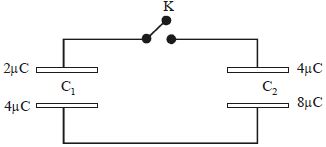
- 9Assertion : Charges are given to plates of two plane parallel plate capacitors $C_1$ and $C_2$ (such that $C_2 = 2C_1$ ) as shown in figure. Then the key $K$ is pressed to complete the circuit. Finally the net charge on upper plate and net charge the circuit. Finally the net charge on upper plate and net charge on lower plate of capacitor $C_1$ is positive.View Solution
Reason : In a parallel plate capacitor both plates always carry equal and opposite charge.
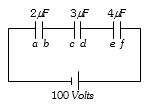
- 10Three capacitors are connected to $D.C.$ source of $100\;volts$ shown in the adjoining figure. If the charge accumulated on plates of ${C_1},\;{C_2}$ and ${C_3}$ are ${q_a},\;{q_b},\;{q_c},{q_d}.{q_e}$ and ${q_f}$ respectively, thenView Solution