Three concentric metallic spherical shell $A, B$ and $C$ or radii $a, b$ and $c$ $(a < b < c)$ have surface charge densities $- \sigma , + \sigma ,$ and $- \sigma $ respectively. The potential of shell $A$ is :
Diffcult


Download our appand get started for free
Experience the future of education. Simply download our apps or reach out to us for more information. Let's shape the future of learning together!No signup needed.*
Similar Questions
- 1Three concentric metal shells $A, B$ and $C$ of respective radii $a, b$ and $c (a < b < c)$ have surface charge densities $+\sigma,-\sigma$ and $+\sigma$ respectively. The potential of shell $B$ isView Solution
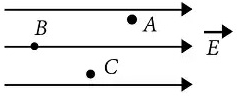
- 2$A, B$ and $C$ are three points in a uniform electric field. The electric potential isView Solution
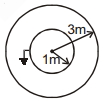
- 3Figure shows a solid conducting sphere of radius $1 m$, enclosed by a metallic shell of radius $3 \,m$ such that their centres coincide. If outer shell is given a charge of $6 \,\mu C$ and inner sphere is earthed, find magnitude charge on the surface of inner shell is ............. $\mu C$View Solution
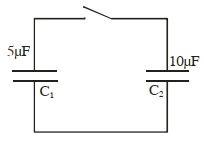
- 4A capacitor $C _{1}$ of capacitance $5\,\mu F$ is charged to a potential of $30\,V$ using a battery. The battery is then removed and the charged capacitor is connected to an uncharged capacitor $C _{2}$ of capacitance $10\,\mu F$ as shown in figure. When the switch is closed charge flows between the capacitors. At equilibrium, the charge on the capacitor $C _{2}$ is________ $\mu C$View Solution
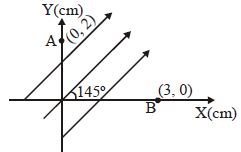
- 5A uniform electric field of $400 \,v/m$ is directed $45^o$ above the $x$ - axis. The potential difference $V_A - V_B$ is -.....$V$View Solution
- 6Concentric metallic hollow spheres of radii $R$ and $4 R$ hold charges $Q _{1}$ and $Q _{2}$ respectively. Given that surface charge densities of the concentric spheres are equal, the potential difference $V ( R )- V (4 R )$ isView Solution
- 7View SolutionAn air capacitor is connected to a battery. The effect of filling the space between the plates with a dielectric is to increase
- 8A parallel plate capacitor of capacitance $12.5 \mathrm{pF}$ is charged by a battery connected between its plates to potential difference of $12.0 \mathrm{~V}$. The battery is now disconnected and a dielectric slab $\left(\in_{\mathrm{r}}=6\right)$ is inserted between the plates. The change in its potential energy after inserting the dielectric slab is_______.$\times 10^{-12} \mathrm{~J}$.View Solution
- 9Charges $-q,\, q,\,q$ are placed at the vertices $A$, $B$, $C$ respectively of an equilateral triangle of side $'a'$ as shown in the figure. If charge $-q$ is released keeping remaining two charges fixed, then the kinetic energy of charge $(-q)$ at the instant when it passes through the mid point $M$ of side $BC$ isView Solution
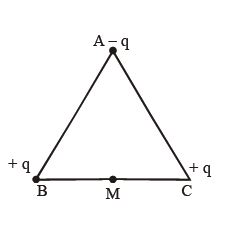
- 10In a uniform electric field, the potential is $10$ $V $ at the origin of coordinates, and $8$ $V$ at each of the points $(1, 0, 0), (0, 1, 0) $ and $(0, 0, 1)$. The potential at the point $(1, 1, 1)$ will be....$V$View Solution