Three copper wires of lengths and cross sectional areas are $(l,\,A),\,(2l,\,A/2)$ and $(l/2,\, 2A)$ . Resistance is minimum in
AIIMS 2013,AIPMT 1997, Easy


Download our appand get started for free
Experience the future of education. Simply download our apps or reach out to us for more information. Let's shape the future of learning together!No signup needed.*
Similar Questions
- 1In an electrolyte $3.2 \times {10^{18}}$ bivalent positive ions drift to the right per second while $3.6 \times {10^{18}}$ monovalent negative ions drift to the left per second. Then the current isView Solution
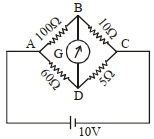
- 2The four arms of a Wheatstone bridge have resistances as shown in the figure. A galvanometer of $15\, \Omega$ resistance is connected across $BD$. Calculate the current through the galvanometer when a potential difference of $10\, V$ is maintained across $AC.$View Solution
- 3$12$ cells each having same $emf$ are connected in series with some cells wrongly connected. The arrangement is connected in series with an ammeter and two cells which are in series. Current is $3 \,A$ when cells and battery aid each other and is $2\, A$ when cells and battery oppose each other. The number of cells wrongly connected isView Solution
- 4A uniform wire of resistance $9$ $\Omega$ is cut into $3$ equal parts. They are connected in the form of equilateral triangle $ABC$. A cell of $e.m.f.$ $2\,V$ and negligible internal resistance is connected across $B$ and $C$. Potential difference across $AB$ is ............... $V$View Solution
- 5A wire when connected to $220\,V$ mains supply has power dissipation ${P_1}$. Now the wire is cut into two equal pieces which are connected in parallel to the same supply. Power dissipation in this case is ${P_2}$. Then ${P_2}:{P_1}$ isView Solution
- 6View SolutionThe relaxation time in conductors
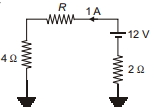
- 7Value of the resistance $R$ in the figure is .......... $\Omega$View Solution
- 8View SolutionIf an electric current is passed through a nerve of a man, then man
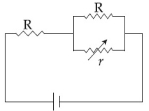
- 9In the circuit shown, the resistance $r$ is a variable resistance. If for $r = fR,$ the heat generation in $r$ is maximum then the value of $f$ isView Solution
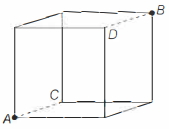
- 10A cube is formed with ten identical resistances $R$ (thick lines) and two shorting wires (dotted lines) along the arms $A C$ and $B D$ as shown in the figure below. Resistance between point $A$ and $B$ is ...........$\Omega$View Solution