Question
Three different objects of masses ${m_1},{m_2}$ and ${m_3}$ are allowed to fall from rest and from the same point $‘O’$ along three different frictionless paths. The speeds of the three objects, on reaching the ground, will be in the ratio of
Answer

(c) Speed of the object at reaching the ground $v = \sqrt {2gh} $

If heights are equal then velocity will also be equal.

Need a full question paper?

Generate a complete, print-ready paper with questions like this in minutes — across 16+ boards, with answer keys.

Start Generating Free

Similar questions

In a transistor amplifier, $\beta = 62, R_L = 5000\, \Omega$ and internal resistance of the  transistor is $500\, \Omega$. The voltage amplification of the amplifier will be:
A long solenoid is formed by winding $20$ $turns/cm$. The current necessary to produce a magnetic field of $20$ $milli\,tesla$ inside the solenoid will be approximately .....$A$ $(\frac{{{\mu _0}}}{{4\pi }} = {10^{ - 7}}\,tesla - metre/ampere)$
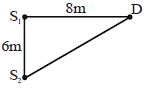
In the figure the intensity of waves arriving at $D$ from two coherent sources $S_1$ and $S_2$ is $2I_0$. The wave length of the wave is $\lambda  = 8\,m$. Resultant intensity at $D$ will be
In the List-$I$ below, four different paths of a particle are given as functions of time. In these functions, $\alpha$ and $\beta$ are positive constants of appropriate dimensions and $\alpha \neq \beta$. In each case, the force acting on the particle is either zero or conservative. In List-II, five physical quantities of the particle are mentioned: $\overrightarrow{ p }$ is the linear momentum, $\bar{L}$ is the angular momentum about the origin, $K$ is the kinetic energy, $U$ is the potential energy and $E$ is the total energy. Match each path in List-$I$ with those quantities in List-$II$, which are conserved for that path.
List-$I$ List-$II$
$P$ $\dot{r}(t)=\alpha t \hat{t}+\beta t \hat{j}$ $1$ $\overrightarrow{ p }$
$Q$ $\dot{r}(t)=\alpha \cos \omega t \hat{i}+\beta \sin \omega t \hat{j}$ $2$ $\overrightarrow{ L }$
$R$ $\dot{r}(t)=\alpha(\cos \omega t \hat{i}+\sin \omega t \hat{j})$ $3$ $K$
$S$ $\dot{r}(t)=\alpha t \hat{i}+\frac{\beta}{2} t^2 \hat{j}$ $4$ $U$
  $5$ $E$
Two bodies $A$ and $B$ of same mass, area and surface finish with specific heats $S_A$ and $S_B\left(S_A > S_B\right)$ are allowed to cool for given temperature range. Temperature varies with time as ..........
The relation between position $( x )$ and time ( $t$ ) are given below for a particle moving along a straight line. Which of the following equation represents uniformly accelerated motion? [where $\alpha$ and $\beta$ are positive constants]
How will the diffraction pattern change when yellow light is replaced by blue light? The fringe will be :-
A body rotating at $20\ rad/sec$ is acted upon by a constant torque providing it a deceleration of $2\ rad/sec^2$. At what time will the body have kinetic energy same as the initial value if the torque continues to act ...... $\sec.$
When connected across the terminals of a cell, a voltmeter measures $5\,V$ and a connected ammeter measures $10\, A$ of current. A resistance of $2\, ohms$ is connected across the terminals of the cell. The current flowing through this resistance will be ............ $A$
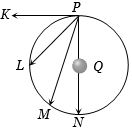
In the figure the charge $Q$ is at the centre of the circle. Work done is maximum when another charge is taken from point $P$ to