(b)
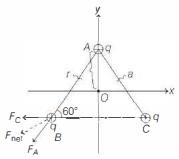
In given charge configuration,
Net force on any of charge is
$F_{\text {net }}=\sqrt{F_A^2+F_B^2+2 F_A F_B \cos 60^{0}}$
$=\frac{\sqrt{3} \cdot q^2}{4 \pi \varepsilon_{0} a^2}$
where, $a=$ side length of equilateral triangle.
So, radius $r$ is $r=\frac{2}{3}\left(\frac{\sqrt{3}}{2} a\right)$
$\Rightarrow \quad a=\sqrt{3} r$
$\text { Hence, } F_{\text {net }}=\frac{\sqrt{3} \cdot q^2}{\left(4 \pi \varepsilon_0\right) 3 r^2}$
or $F_{\text {net }}=\frac{q^2}{\left(4 \pi \varepsilon_0\right) \sqrt{3} r^2}$
Now, given that this force is balanced by a force $F(r)=k r$
$\therefore k r =\frac{q^2}{\left(4 \pi \varepsilon_0\right) \sqrt{3} r^2}$
$\Rightarrow r^3=\frac{\sqrt{3} q^2}{12 \pi \varepsilon_0 k}$
So, $\quad r=\left(\frac{\sqrt{3} q^2}{12 \pi \varepsilon_0 k}\right)^{\frac{1}{3}}$