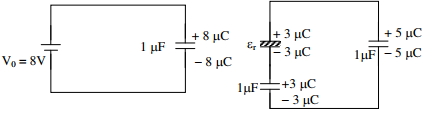
. Three identical capacitors $C _1, C _2$ and $C _3$ have a capacitance of $1.0 \mu F$ each and they are uncharged initially. They are connected in a circuit as shown in the figure and $C _1$ is then filled completely with a dielectric material of relative permittivity $\varepsilon_{ r }$. The cell electromotive force (emf) $V_0=8 V$. First the switch $S_1$ is closed while the switch $S_2$ is kept open. When the capacitor $C_3$ is fully charged, $S_1$ is opened and $S_2$ is closed simultaneously. When all the capacitors reach equilibrium, the charge on $C _3$ is found to be $5 \mu C$. The value of $\varepsilon_{ r }=$. . . . .
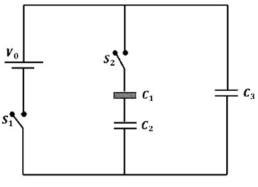
IIT 2018, Advanced


Download our appand get started for free
Experience the future of education. Simply download our apps or reach out to us for more information. Let's shape the future of learning together!No signup needed.*
Similar Questions
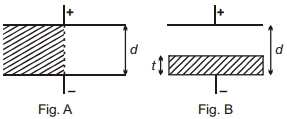
- 1A capacitor is half filled with a dielectric $(K=2)$ as shown in figure A. If the same capacitor is to be filled with same dielectric as shown, what would be the thickness of dielectric so that capacitor still has same capacity?View Solution
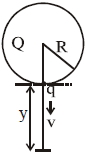
- 2A solid sphere of radius $R$ carries a charge $(Q+q)$ distributed uniformly over its volume. A very small point like piece of it of mass $m$ gets detached from the bottom of the sphere and falls down vertically under gravity. This piece carries charge $q.$ If it acquires a speed $v$ when it has fallen through a vertical height $y$ (see figure), then :View Solution
(assume the remaining portion to be spherical).
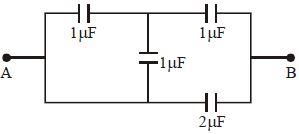
- 3The equivalent capacitance between points $A$ and $B$ of the circuit shown will beView Solution
- 4View SolutionThe potential to which a conductor is raised, depends on
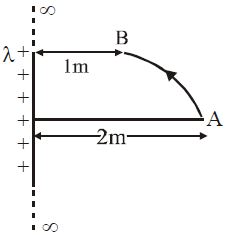
- 5Figure shows a positively charged infinite wire. $A$ particle of charge $2C$ moves from point $A$ to $B$ with constant speed. (Given linear charge density on wire is $\lambda = 4 \pi \varepsilon_0$)View Solution
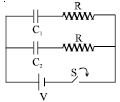
- 6In the circuit shown in figure $C_1=2C_2$. Switch $S$ is closed at time $t=0$. Let $i_1$ and $i_2$ be the currents flowing through $C_1$ and $C_2$ at any time $t$, then the ratio $i_1/ i_2$View Solution
- 7The capacitance of an air capacitor is $15\,\mu F$ the separation between the parallel plates is $6\,mm$. A copper plate of $3\,mm$ thickness is introduced symmetrically between the plates. The capacitance now becomes.........$\mu F$View Solution
- 8There is an electric field $E$ in $X$-direction. If the work done on moving a charge $0.2\,C$ through a distance of $2\,m$ along a line making an angle $60^\circ $ with the $X$-axis is $4.0\;J$, what is the value of $E$........ $N/C$View Solution
- 9Two small equal point charges of magnitude $q$ are suspended from a common point on the ceiling by insulating mass less strings of equal lengths. They come to equilibrium with each string making angle $\theta $ from the vertical. If the mass of each charge is $m,$ then the electrostatic potential at the centre of line joining them will be $\left( {\frac{1}{{4\pi { \in _0}}} = k} \right).$View Solution
- 10View SolutionAssertion : A metallic shield in form of a hollow shell may be built to block an electric field.
Reason : In a hollow spherical shield, the electric field inside it is zero at every point.