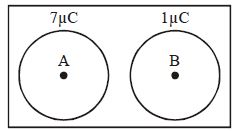
$A$ and $B$ are two identical spheres charge on them is $7\,\mu C$ and $1\,\mu C$ respectively. Now both are connected by a wire. Calculate flow of charge from $A$ to $B$......$\mu C$
Medium


Download our appand get started for free
Experience the future of education. Simply download our apps or reach out to us for more information. Let's shape the future of learning together!No signup needed.*
Similar Questions
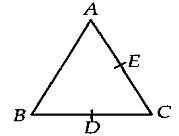
- 1Three charges, each $+q,$ are placed at the comers of an isosceles triangle $ABC$ of sides $BC$ and $AC, 2a.$ $D$ and $E$ are the mid-points of $BC$ and $CA.$ The work done in taking a charge $Q$ from $D$ to $E$ isView Solution
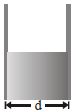
- 2A parallel plate air capacitor has a capacitance $C$. When it is half filled with a dielectric of dielectric constant $5$, the percentage increase in the capacitance will be......$\%$View Solution
- 3Ten charges are placed on the circumference of a circle of radius $R$ with constant angular separation between successive charges. Alternate charges $1,3,5,7,9$ have charge $(+q)$ each, while $2,4,6,8,10$ have charge $(-q)$ each. The potential $V$ and the electric field $E$ at the centre of the circle are respectivelyView Solution
(Take $V =0$ at infinity $)$
- 4An electric dipole has the magnitude of its charge as $q$ and its dipole moment is $p$. It is placed in a uniform electric field $E$. If its dipole moment is along the direction of the field, the force on it and its potential energy are respectivelyView Solution
- 5A $60\; pF$ capacitor is fully charged by a $20\; \mathrm{V}$ supply. It is then disconnected from the supply and is connected to another uncharged $60 \;pF$ capactior is parallel. The electrostatic energy that is lost in this process by the time the charge is redistributed between them is (in $nJ$)View Solution
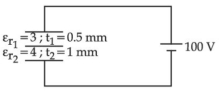
- 6A composite parallel plate capacitor is made up of two different dielectric materials with different thickness $\left(t_{1}\right.$ and $\left.t_{2}\right)$ as shown in figure. The two different dielectric material are separated by a conducting foil $F$. The voltage of the conducting foil is $.....V$View Solution
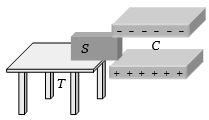
- 7A frictionless dielectric plate $S$ is kept on a frictionless table $T$. A charged parallel plate capacitance $C$ (of which the plates are frictionless) is kept near it. The plate $S$ is between the plates. When the plate $S$ is left between the platesView Solution
- 8View SolutionPutting a dielectric substance between two plates of condenser, capacity, potential and potential energy respectively
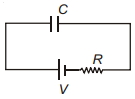
- 9As in the figure, if a capacitor of capacitance $C$ is charged by connecting it with resistance $R$, then energy given by the battery will beView Solution
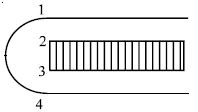
- 10Four identical plates $1, 2, 3$ and $4$ are placed parallel to each other at equal distance as shown in the figure. Plates $1$ and $4$ are joined together and the space between $2$ and $3$ is filled with a dielectric of dielectric constant $k$ $=$ $2$. The capacitance of the system between $1$ and $3$ $\&$ $2$ and $4$ are $C_1$ and $C_2$ respectively. The ratio $\frac{{{C_1}}}{{{C_2}}}$ isView Solution