The plates of a parallel plate capacitor of capacity $50\,\mu C$ are charged to a potential of $100\;volts$ and then separated from each other so that the distance between them is doubled. How much is the energy spent in doing so
Medium


Download our appand get started for free
Experience the future of education. Simply download our apps or reach out to us for more information. Let's shape the future of learning together!No signup needed.*
Similar Questions
- 1A body of capacity $4\,\mu \,F$ is charged to $80\,V$ and another body of capacity $6\,\mu \,F$ is charged to $30\,V$. When they are connected the energy lost by $4\,\mu \,F$ capacitor is.......$mJ$View Solution
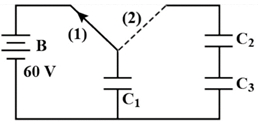
- 2A capacitor $C_1$ is charged up to a voltage $V\, = 60\,V$ by connecting it to battery $B$ through switch $( 1)$, Now $C_1$ is disconnected from battery and connected to a circuit consisting of two uncharged capacitors $C_2\, = 3.0\,\mu F$ and $C_3\,= 6.0\,\mu F$ through a switch $(2)$ as shown in the figure. The sum of final charges on $C_2$ and $C_3$ is......$\mu C$View Solution
- 3The insulated spheres of radii ${R_1}$ and ${R_2}$ having charges ${Q_1}$and ${Q_2}$ respectively are connected to each other. There isView Solution
- 4$X $ and $Y$ are large, parallel conducting plates closed to each other. Each face has an area $A$. $X$ is given a charge $Q$. $Y$ is without any charge. Points $A, B$ and $C$ are as shown in figure.View Solution

- 5Two insulated metallic spheres of $3\,\mu F$ and $5\,\mu F$ capacitances are charged to $300\, V$ and $500\,V$ respectively. The energy loss, when they are connected by a wire isView Solution
- 6View SolutionThe vehicles carrying inflammable fluids usually have metallic chains touching the ground:
- 7A $500\,\mu F$ capacitor is charged at a steady rate of $100\,\mu C/sec$ . The potential difference across the capacitor will be $10\,V$ after an interval of......$sec$View Solution
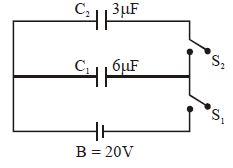
- 8In the circuit shown here $C_1 = 6\,\mu F, C_2 = 3 \,\mu F$ and battery $B = 20\,V$. The switch $S_1$ is first closed. It is then opened and afterwards $S_2$ is closed. What is the charge (in $\mu F$)finally on $C_2$ ?View Solution
- 9Three capacitors of capacitance $3\,\mu \,F,\,10\,\mu \,F\,$ and $15\,\mu \,F\,$ are connected in series to a voltage source of $100\,V$. The charge on $15\,\mu \,F\,$is.......$\mu C$View Solution
- 10A parallel plate capacitor carries a charge $q$. The distance between the plates is doubled by application of a force. The work done by the force isView Solution