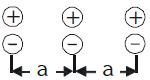
Three identical small electric dipoles are arranged parallel to each other at equal separation a as shown in the figure. Their total interaction energy is $U$. Now one of the end dipole is gradually reversed, how much work is done by the electric forces.
Diffcult


Download our appand get started for free
Experience the future of education. Simply download our apps or reach out to us for more information. Let's shape the future of learning together!No signup needed.*
Similar Questions
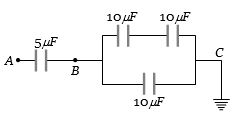
- 1In the given circuit if point $C$ is connected to the earth and a potential of $ + \,2000\,V$ is given to the point $A$, the potential at $B$ is.....$V$View Solution
- 2A conducting sphere of radius $10\, cm$ is charged $10\,\mu \,C$. Another uncharged sphere of radius $20\, cm$ is allowed to touch it for some time. After that if the sphere are separated, then surface density of charges, on the spheres will be in the ratio ofView Solution
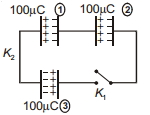
- 3Three identical charged capacitors each of capacitance $5 \,\mu F$ are connected as shown in figure. Potential difference across capacitor $(3)$, long time after the switches $K_1$ and $K_2$ are is closed, is ............ $V$View Solution
- 4A $10\, micro-farad$ capacitor is charged to $500\, V$ and then its plates are joined together through a resistance of $10\, ohm$. The heat produced in the resistance is........$J$View Solution
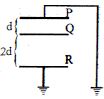
- 5See the diagram . Area of each plate is $2.0\ m^2$ and $d = 2 \times 10^{-3}\ m$. A charge of $8.85 \times 10^{-8}\ C$ is given to $Q$. Then the potential of $Q$ becomes......$V$View Solution
- 6The potential at a point, due to a positive charge of $100\,\mu C$ at a distance of $9\,m$, isView Solution
- 7The charges on two plates of a $10\,\mu f$ capacitor are $5\,\mu C$ and $15\,\mu C$ then the potential difference across the capacitor plates is........$V$View Solution
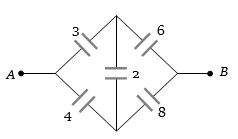
- 8Effective capacitance between $A$ and $B$ in the figure shown is (all capacitance are in $\mu F$)View Solution
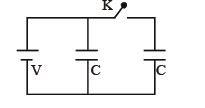
- 9Consider the arrangement shown in figure. The total energy stored is $U_1$ when key is closed. Now the key $K$ is made off (opened) and two dielectric slabs of relative permittivity ${ \in _r}$ are introduced between the plates of the two capacitors. The slab tightly fit in between the plates. The total energy stored is now $U_2$. Then the ratio of $U_1/U_2$ isView Solution
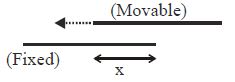
- 10A parallel-plate capacitor consists of a fixed plate and a movable plate that is allowed to slide in the direction parallel to the plates. Let $x$ be the distance of overlap, as shown in the figure. The separation between the plates is fixed. Assume that the plates are electrically isolated, so that their charges $±Q$ are constant. Force on the movable plate is proportional toView Solution