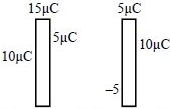
The charges on two plates of a $10\,\mu f$ capacitor are $5\,\mu C$ and $15\,\mu C$ then the potential difference across the capacitor plates is........$V$
Medium


Download our appand get started for free
Experience the future of education. Simply download our apps or reach out to us for more information. Let's shape the future of learning together!No signup needed.*
Similar Questions
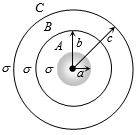
- 1Three concentric metallic shells $A, B$ and $C$ of radii $a, b$ and $c (a < b < c)$ have surface charge densities $\sigma ,\, - \sigma $ and $\sigma $ respectively. then ${V_A}$ and ${V_B}$View Solution
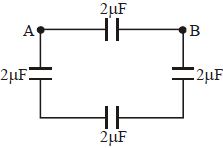
- 2The equivalent capacitance between the points $A$ and $B$ in the given diagram isView Solution
- 3A capacitor of capacitance $\mathrm{C}$ and potential $\mathrm{V}$ has energy $E$. It is connected to another capacitor of capacitance $2 \mathrm{C}$ and potential $2 \mathrm{~V}$. Then the loss of energy is $\frac{x}{3} E$, where $\mathrm{x}$ is____________.View Solution
- 4View SolutionAssertion : Two equipotential surfaces cannot cut each other.
Reason : Two equipotential surfaces are parallel to each other.
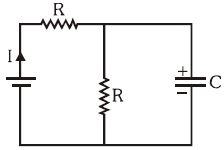
- 5In the given figure initially the capacitor is uncharged. Ratio of current at $t = 0$ & $t = \infty$ will beView Solution
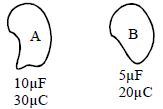
- 6When two isolated conductors $A$ and $B$ are connected by a conducting wire positive charge will flow from :-View Solution
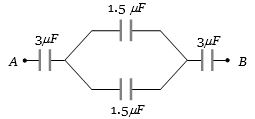
- 7The capacitance between the points $A$ and $B$ in the given circuit will be.......$\mu \,F$View Solution
- 8A $700\,pF$ capacitor is charged by a $50\,V$ battery. The electrostatic energy stored by it isView Solution
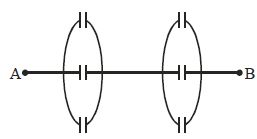
- 9All the six capacitors shown in the circuit are identical. Each can withstand maximum $200\, volt$ between its terminals. The maximum voltage that can be applied safely between $A$ and $B$ is.....$V$View Solution
- 10The two metallic plates of radius $r$ are placed at a distance $d$ apart and its capacity is $C$. If a plate of radius $r/2$ and thickness $d$ of dielectric constant $6$ is placed between the plates of the condenser, then its capacity will beView Solution