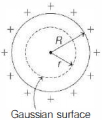
If some charge is given to a solid metallic sphere, the field inside remains zero and by Gauss's law all the charge resides on the surface. Now, suppose that Coulomb's force between two charges varies as $1 / r^{3}$. Then, for a charged solid metallic sphere
KVPY 2017, Advanced
Download our app for free and get startedPlay store
$(d)$ As Coulomb's force,

$\quad F \propto \frac{1}{r^{3}}$

$\Rightarrow \text { Electric field, } E \propto \frac{1}{r^{3}} \Rightarrow E=\frac{k q}{r^{3}}$

Now, for Gaussian surface $(r < R)$.

Electric flux linked with surface is

$\phi=\int \frac{k q}{r^{3}} \cdot 2 \pi r d r$

$=2 \pi k q \int \frac{d r}{r^{2}}=2 \pi k q\left(-\frac{1}{r}\right)$

As flux is non-zero, charge density is also non-zero. Also, by symmetry of charge distribution electric field is zero.

art

Download our app
and get started for free

Experience the future of education. Simply download our apps or reach out to us for more information. Let's shape the future of learning together!No signup needed.*

Similar Questions

  • 1
    A parallel plate air capacitor is charged and then isolated. When a dielectric material is inserted between the plates of the capacitor, then which of the following does not change
    View Solution
  • 2
    A condenser of capacity $50\,\mu F$ is charged to $10\;volts$. Its energy is equal to
    View Solution
  • 3
    Figure shows a solid metal sphere of radius $‘a’$ surrounded by a concentric thin metal shell of radius $2a$ . Initially both are having charges $Q$ each. When the two are connected by a conducting wire as shown in the figure, then amount of heat produced in this process will be 
    View Solution
  • 4
    Inside a hollow charged spherical conductor, the potential
    View Solution
  • 5
    A condenser of capacitance $10\,\mu F$ has been charged to $100\,volts$. It is now connected to another uncharged condenser in parallel. The common potential becomes $40\,volts$. The capacitance of another condenser is......$\mu F$
    View Solution
  • 6
    Consider a simple $RC$ circuit as shown in Figure $1$.

    Process $1$: In the circuit the switch $S$ is closed at $t=0$ and the capacitor is fully charged to voltage $V_0$ (i.e. charging continues for time $T \gg R C$ ). In the process some dissipation ( $E_D$ ) occurs across the resistance $R$. The amount of energy finally stored in the fully charged capacitor is $EC$.

    Process $2$: In a different process the voltage is first set to $\frac{V_0}{3}$ and maintained for a charging time $T \gg R C$. Then the voltage is raised to $\frac{2 \mathrm{~V}_0}{3}$ without discharging the capacitor and again maintained for time $\mathrm{T} \gg \mathrm{RC}$. The process is repeated one more time by raising the voltage to $V_0$ and the capacitor is charged to the same final

    take $\mathrm{V}_0$ as voltage

    These two processes are depicted in Figure $2$.

     ($1$) In Process $1$, the energy stored in the capacitor $E_C$ and heat dissipated across resistance $E_D$ are released by:

    $[A]$ $E_C=E_D$ $[B]$ $E_C=E_D \ln 2$ $[C]$ $\mathrm{E}_{\mathrm{C}}=\frac{1}{2} \mathrm{E}_{\mathrm{D}}$ $[D]$ $E_C=2 E_D$

     ($2$) In Process $2$, total energy dissipated across the resistance $E_D$ is:

    $[A]$ $\mathrm{E}_{\mathrm{D}}=\frac{1}{2} \mathrm{CV}_0^2$     $[B]$ $\mathrm{E}_{\mathrm{D}}=3\left(\frac{1}{2} \mathrm{CV}_0^2\right)$    $[C]$ $\mathrm{E}_{\mathrm{D}}=\frac{1}{3}\left(\frac{1}{2} \mathrm{CV}_0^2\right)$   $[D]$ $\mathrm{E}_{\mathrm{D}}=3 \mathrm{CV}_0^2$

    Given the answer quetion  ($1$) and  ($2$)

    View Solution
  • 7
    Find the ratio of energy stored in $5\,\mu F$ and $4\,\mu F$ capacitor in the given circuit in steady state
    View Solution
  • 8
    Find equivalent capacitance between $A$ and $B$......$C$
    View Solution
  • 9
    Two identical charged spheres are suspended by string of equal lengths. The string make an angle of $37^{\circ}$ with each other. When suspended in a liquid of density $0.7 \mathrm{~g} / \mathrm{cm}^3$, the angle remains same. If density of material of the sphere is $1.4 \mathrm{~g} / \mathrm{cm}^3$, the dielectric constant of the liquid is_____$\left(\tan 37^{\circ}=\frac{3}{4}\right)$.
    View Solution
  • 10
    A number of capacitors each of capacitance $1\,\mu F$ and each one of which get punctured if a potential difference just exceeding $500\,volt$ is applied, are provide, then an arrangement suitable for givin  a capacitance of $2\,\mu F$ across which $3000\,volt$ may be applied requires at least
    View Solution