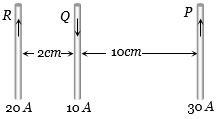
Three long, straight and parallel wires carrying currents are arranged as shown in figure. The force experienced by $10\, cm$ length of wire $Q$ is
Diffcult
Download our app for free and get started
(a) Force on wire $Q$ due to wire $P$ is
${F_P} = {10^{ - 7}} \times \frac{{2 \times 30 \times 10}}{{0.1}} \times 0.1$$ = 6 \times {10^{ - 5}}\,N$ (Towards left)
Force on wire $Q$ due to wire $R$ is
${F_R} = {10^{ - 7}} \times \frac{{2 \times 20 \times 10}}{{0.02}} \times 0.1 = 20 \times {10^{ - 5}}\,N$ (Towards right)
Hence ${F_{net}} = {F_R} - {F_P} = 14 \times {10^{ - 5}}\,N = 1.4 \times {10^{ - 4}}\,N$
(Towards right)
Download our app
and get started for free
Experience the future of education. Simply download our apps or reach out to us for more information. Let's shape the future of learning together!No signup needed.*
A closely wound solenoid of $2000$ $turns$ and area of cross-section $1.5 \times 10^{-4}\ m^2$ carries a current of $2.0\, A.$ It is suspended through its centre and perpendicular to its length, allowing it to turn in a horizontal plane in a uniform magnetic field $5 \times 10^{- 2}$ $tesla$ making an angle of $30^o $ with the axis of the solenoid. The torque on the solenoid will be
The magnitude of the magnetic field at the centre of an equilateral triangular loop of side $1\,m$ which is carrying a current of $10\,A$ is:......$\mu T$ [Take $\mu _0 = 4\pi \times 10^{-7}\,NA^{-2}$]
A long solenoid has a radius $a$ and number of turns per unit length is $n$. If it carries a current $i$, then the magnetic field on its axis is directly proportional to
Two long straight parallel wires, carrying (adjustable) current $I_1$ and $I_2$, are kept at a distance $d$ apart. If the force $'F'$ between the two wires is taken as 'positive' when the wires repel each other and 'negative' when the wires attract each other, the graph showing the dependence of $'F'$, on the product $I_1 I_2$, would be
In the given diagram a rod is rotating with angular velocity $\omega $. Mass of this rod is $m$ charge $q$ and length $l$ then find out magnetic moment of this rod
Ionized hydrogen atoms and $\alpha$ -particles with same momenta enters perpendicular to a constant magnetic field $B$. The ratio of their radii of their paths $\mathrm{r}_{\mathrm{H}}: \mathrm{r}_{\alpha}$ will be
A galvanometer of $10 \,\Omega$ resistance gives full scale deflection with $0.01$ ampere of current. It is to be converted into an ammeter for measuring $10$ ampere current. The value of shunt resistance required will be
An electron moves through a uniform magnetic field $\vec{B}=B_0 \hat{i}+2 B_0 \hat{j} T$. At a particular instant of time, the velocity of electron is $\overrightarrow{\mathrm{u}}=3 \hat{i}+5 \hat{j} \mathrm{~m} / \mathrm{s}$. If the magnetic force acting on electron is $\overrightarrow{\mathrm{F}}=5 \mathrm{ekN}$, where $e$ is the charge of electron, then the value of $\mathrm{B}_0$ is ____$\mathrm{T}$.
The radius of a circular ring of wire is $R$ and it carries a current of $I\,ampere$. At its centre a smaller ring of radius $r$ with current $i$ and $N\, turns$ is placed. Assuming that the planes of two rings are perpendicular to each other and the magnetic induction produced at the centre of bigger ring is constant, then the torque acting on smaller ring will be