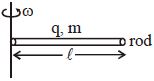
In the given diagram a rod is rotating with angular velocity $\omega $. Mass of this rod is $m$ charge $q$ and length $l$ then find out magnetic moment of this rod
Medium
Download our app for free and get started
$ \frac{M}{L} =\frac{q}{2 m} $
$ M =\frac{q L}{2 m}=\frac{q I \omega}{2 m} $
$=\frac{q \omega}{2 m} \times \frac{m \ell^{2}}{3}\left(I=\frac{m \ell^{2}}{3}\right)$
$=\frac{q \omega \ell^{2}}{6} $

Download our appand get started for free
Experience the future of education. Simply download our apps or reach out to us for more information. Let's shape the future of learning together!No signup needed.*
Similar Questions
- 1A charge moving with velocity $v$ in $X$-direction is subjected to a field of magnetic induction in the negative $X$-direction. As a result, the charge willView Solution
- 2In the previous question, if the current is $i$ and the magnetic field at $D$ has magnitude $B$,View Solution
- 3To convert a $800\, mV$ range milli voltmeter of resistance $40 \,\Omega$ into a galvanometer of $100\, mA$ range, the resistance to be connected as shunt is .............. $\Omega $View Solution
- 4A proton moving with a velocity, $2.5 \times {10^7}\,m/s$, enters a magnetic field of intensity $2.5\,T$ making an angle ${30^o}$ with the magnetic field. The force on the proton isView Solution
- 5The pole strength of a bar magnet is $48$ $ampere-metre$ and the distance between its poles is $ 25 \,cm$ . The moment of the couple by which it can be placed at an angle of $30°$ with the uniform magnetic intensity of flux density $0.15 $ $Newton /ampere-metre$ will be.......$Newton × metre$View Solution
- 6To know the resistance $G$ of a galvanometer by half deflection method, a battery of $emf\, V_E$ and resistance $R$ is used to deflect the galvanometer by angle $\theta $. If a shunt of resistance $S$ is needed to get half deflection then $G, R$ and $S$ related by the equationView Solution
- 7A coil having $100$ turns, area of $5 \times 10^{-3} \mathrm{~m}^2$, carrying current of $1 \mathrm{~mA}$ is placed in uniform magnetic field of $0.20 \mathrm{~T}$ such a way that plane of coil is perpendicular to the magnetic field. The work done in turning the coil through $90^{\circ}$ is . . . . . . $\mu \mathrm{J}$.View Solution
- 8A power line lies along the east-west direction and carries a current of $10\, ampere$. The force per metre due to the earth's magnetic field of ${10^{ - 4}}\,tesla$ isView Solution
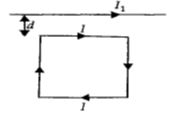
- 9A square loop, carrying a steady current $I,$ is placed in a horizontal plane near a long straight conductor carrying a steady current $I_1$ at a distance $d$ from the conductor as shown in figure. The loop will experienceView Solution
- 10Three long current carrying wires $P, Q$ and $R$ placed perpendicular to plane of the paper. Magnetic force per unit length on wire $'R'$ isView Solution