Three musicians experiment with the Doppler effect. Musician $A$ rides in a car at a speed $u$ directly away from musician $B$ who is stationary. Musician $C$ rides in a car directly toward $B$ and travels at the same speed as $A$ . Musician $A$ plays a note at frequency $f_A$ on his trumpet $B$ hears the note, adjusts his trumpet, and plays the same note he heard. Choose the incorrect statement

Medium
Download our app for free and get started
$\mathrm{f}_{\mathrm{B}}=\frac{\mathrm{c}}{\mathrm{c}+\mathrm{u}} \mathrm{f}_{\mathrm{A}}<\mathrm{f}_{\mathrm{A}}$
Heard by $Af_B^\prime = \frac{{c - u}}{c}{f_B} = \frac{{c - u}}{{c + u}}{f_A} < {f_A}$

Download our appand get started for free
Experience the future of education. Simply download our apps or reach out to us for more information. Let's shape the future of learning together!No signup needed.*
Similar Questions
- 1View SolutionIn the experiment to determine the speed of sound using a resonance column,
- 2A standing wave is formed by the superposition of two waves travelling in opposite directions. The transverse displacement is given by $y\left( {x,t} \right) = 0.5\sin\, \left( {\frac{{5\pi }}{4}x} \right)\,\cos\, \left( {200\,\pi t} \right)$. What is the speed of the travelling wave moving in the positive $x$ direction .... $m/s$ ? ($x$ and $t$ are in meter and second, respectively.)View Solution
- 3Two identical wires have the same fundamental frequency of $400 Hz$. when kept under the same tension. If the tension in one wire is increased by $2\%$ the number of beats produced will beView Solution
- 4A tuning fork is used to produce resonance in a glass tube. The length of the air column in this tube can be adjusted by a variable piston. At room temperature of $27\,^o C$ two successive resonances are produced at $20\, cm$ and $73\, cm$ of column length. If the frequency of the tuning fork is $320\, Hz,$ the velocity of sound in air at $27\,^o C$ is .... $m/s$View Solution
- 5A source of sound emits waves with frequency $f \,Hz$ and speed $V\, m/sec$. Two observers move away from this source in opposite directions each with a speed $0.2\, V$ relative to the source. The ratio of frequencies heard by the two observers will beView Solution
- 6A closed organ pipe of length $L$ and an open organ pipe contain gases of densities $\rho_{1}$ and $\rho_{2}$ respectively. The compressibility of gases are equal in both the pipes. Both the pipes are vibrating in their first overtone with same frequency. The length of the open pipe is $\frac{ x }{3} L \sqrt{\frac{\rho_{1}}{\rho_{2}}}$ where $x$ is ......... . (Round off to the Nearest Integer)View Solution
- 7The frequency of fundamental tone in an open organ pipe of length $0.48 m$ is $320 Hz.$ Speed of sound is $320 m/sec.$ Frequency of fundamental tone in closed organ pipe will be ... $Hz$View Solution
- 8The figure represents the instantaneous picture of a longitudinal harmonic wave travelling along the negative $x$-axis. Identify the correct statement $(s)$ related to the movement of the points shown in the figure. The points moving opposite to the direction of propagation areView Solution
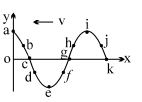
- 9Three harmonic waves having equal frequency $\mathrm{v}$ and same intensity $\mathrm{I}_{0}$, have phase angles $0 , \frac{\pi}{4}$ and $-\frac{\pi}{4}$ respectively. When they are superimposed the intensity of the resultant wave is close toView Solution
- 10Two vehicles, each moving with speed $u$ on the same horizontal straight road, are approaching each other. Wind blows along the road with velocity $w$. One of these vehicles blows a whistle of frequency $f_1$. An observer in the other vehicle hears the frequency of the whistle to be $f _2$. The speed of sound in still air is $V$. The correct statement$(s)$ is (are) :View Solution
$(A)$ If the wind blows from the observer to the source, $f_2 > f_1$.
$(B)$ If the wind blows from the source to the observer, $f_2 > f_1$.
$(C)$ If the wind blows from the observer to the source, $f _2 < f _1$.
$(D)$ If the wind blows from the source to the observer, $f _2 < f _1$.