MCQ
 Three particles start simultaneously from a point on a horizontal smooth plane. First particle moves with speed $v_1$ towards east, second particle moves towards north with speed $v_2$ and third-one moves towards north-east. The velocity of the third particle, so that the three always lie on a line, is
  • A
    $\frac{v_1+v_2}{\sqrt{2}}$
  • B
    $\sqrt{v_1 v_2}$
  • C
    $\frac{v_1 v_2}{v_1+v_2}$
  • $\sqrt{2} \frac{v_1 v_2}{v_1+v_2}$

Answer

Correct option: D.
$\sqrt{2} \frac{v_1 v_2}{v_1+v_2}$
d
(d)

Equation of line $R S$ is $y=-m x+C$

Or $y=-\left(\frac{v_2}{v_1}\right) x+v_2 t$

or $\quad v_1 y=-v_2 x+v_1 v_2 t$

Equation of line $O P$ is

$y=x$

Point $P$ is the point of intersection, we get

$x_P=y_P=\frac{v_1 v_2 t}{v_1+v_2}$

$O P=\sqrt{x_P^2+y_P^2}$

$=\frac{\sqrt{2} v_1 v_2 t}{v_1+v_2}$

$v_3=\frac{O P}{t}=\frac{\sqrt{2} v_1 v_2}{v_1+v_2}$

Need a full question paper?

Generate a complete, print-ready paper with questions like this in minutes — across 16+ boards, with answer keys.

Start Generating Free

Similar questions

The effect of temperature on Maxwell's speed distribution is correctly shown by
The equation of stationary wave along a stretched string is given by $y = 5\sin \frac{{\pi x}}{3}\cos 40\pi t$ where $x$ and $y$ are in centimetre and $t$ in second. The separation between two adjacent nodes is .... $cm$
Two spherical conductors $A$ and $B$ of radii $1\ mm$ and $2\  mm$ are separated by a distance of $5\ cm$ and are uniformly charged. If the spheres are connected by a conducting wire then in equilibrium condition, the ratio of the magnitude of the electric fields at the surfaces of spheres $A$ and $B$ is
A particle of mass $1\,kg$ is moving along $x-$ axis, where its velocity depends on $x-$ coordinate as $v = 2\sqrt x \,(m/s)$. Find the net force acting on the particle $2\,second$ after the start of motion ............ $N$
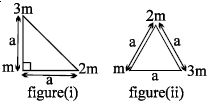
Consider two configurations of a system of three particles of masses $m, 2m$ and $3m.$ The work done by external agent in changing the configuration of the system from figure $(i)$ to figure $(ii)$ is
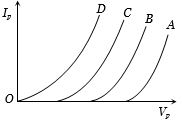
In the figure four plate characteristics of a triode at different grid voltage are shown. The difference between successive grid voltage is $1 V.$  Which curve will have maximum grid voltage and what is its value?
Putting a dielectric substance between two plates of condenser, capacity, potential and potential energy respectively
If the radius and acceleration due to gravity both are doubled, escape velocity of earth will become ......... $km/s$
Potential difference between centre $\&$ the surface of sphere of radius $R$ and uniform volume charge density $\rho$ within it will be :
A beam of light from a source $L$ is incident normally on a plane mirror fixed at a certain distance $x$ from the source. The beam is reflected back as a spot on a scale placed just above the source $L.$ When the mirror is rotated through a small angle $\theta$, the spot of the light is found to move through a distance $y$ on the scale. The angle $\theta$ is given by