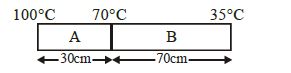
Two different rods $A$ and $B$ are kept as shown in figure. The ratio of thermal conductivities of $A$ and $B$ is
Medium


Download our appand get started for free
Experience the future of education. Simply download our apps or reach out to us for more information. Let's shape the future of learning together!No signup needed.*
Similar Questions
- 1View SolutionNewton's law of cooling is used in laboratory for the determination of the
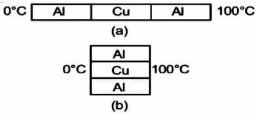
- 2The three rods shown in figure have identical dimensions. Heat flows from the hot end at a rate of $40 \,W$ in the arrangement $(a)$. Find the rates of heat flow when the rods are joined as in arrangement $(b)$ is ......... $W$ (Assume $K_al=200 \,W / m ^{\circ} C$ and $\left.K_{c u}=400 \,W / m ^{\circ} C \right)$View Solution
- 3A black body is at a temperature of $2880\;K$. The energy of radiation emitted by this object with wavelength between $499\;nm$ and $500\;nm$ is ${U_1}$, between $999\;nm$ and $1000\;nm$ is ${U_2}$ and between $1499\;nm$ and $1500\;nm$ is ${U_3}$. The Wein's constant $b = 2.88 \times {10^6}\;nm\,K$. ThenView Solution
- 4Four rods of indentical cross-sectional area and made from the same metal form the sides of a square. The temperature of two diagonally opposite points are $\theta$ and $\sqrt2 \theta$ respectively in the teady state. Assuming that only heat conduction takes place, what will be the temperature difference between other two points ?View Solution
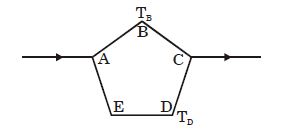
- 5$ABCDE$ is a regular pentagon of uniform wire. The rate of heat entering at $A$ and leaving at $C$ is equal. $T_B$ and $T_D$ are temperature of $B$ and $D$ . Find the temperature $T_C$View Solution
- 6A body takes $5$ minutes to cool from $90^oC$ to $60^oC$. If the temperature of the surroundings is $20^oC$, the time taken by it to cool from $60^oC$ to $30^oC$ will be ...... $\min.$View Solution
- 7The following three objects $(1)$ a metal tray, $(2)$ a block of wood and $(3)$ a woolen cap are left in a closed room overnight. Next day, the temperature of each is recorded as $T_1, T_2$ and $T_3$, respectively. The likely situation isView Solution
- 8Two stars emit maximum radiation at wavelength $3600Å$ and $4800Å$ respectively. The ratio of their temperatures isView Solution
- 9A black body radiates at the rate of $W$ watts at a temperature $T$ . If the temperature of the body is reduced to $T/3$ , it will radiate at the rate of (in Watts)View Solution
- 10Liquid is filled in a vessel which is kept in a room with temperature ${20^o}C$. When the temperature of the liquid is ${80^o}C$, then it loses heat at the rate of $60\;cal/\sec $. What will be the rate of loss of heat when the temperature of the liquid is ${40^o}C$ ....... $cal/\sec $View Solution