MCQ
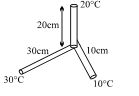
Three rods made of the same material and having same cross-sectional area but different lengths $10\,\,cm$, $\,\,20 cm$ and $30\,\,cm$ are joined as shown. The temperature of the joint is  ....... $^oC$ 
  • A
    $20$
  • B
    $23.7$
  • $16.4$
  • D
    $18.2$

Answer

Correct option: C.
$16.4$
c
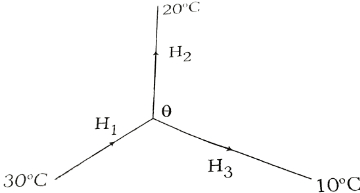
Let $\theta$ be the temperature of junction and $H_{1}, H_{2}$ and $H_{3}$ the heat currents.

Then

$H_{1}=H_2+H_{3}$

$\frac{30-\theta}{\left(\frac{30}{K A}\right)}=\frac{\theta-20}{\left(\frac{20}{K A}\right)}+\frac{\theta-10}{\left(\frac{30}{K A}\right)}$

or $2(30-\theta)=3(\theta-20)+3(2 \theta-20)$

or $\theta=16.36^{\circ} \mathrm{C} \approx 16.4^{\circ} \mathrm{C}$
Need a full question paper?

Generate a complete, print-ready paper with questions like this in minutes — across 16+ boards, with answer keys.
Start Generating Free

Similar questions

A steel rod has a radius of $20\,mm$ and a length of $2.0\,m$. A force of $62.8\,kN$ stretches it along its length. Young's modulus of steel is $2.0 \times 10^{11}\,N / m ^2$. The longitudinal strain produced in the wire is $..........\times 10^{-5}$
An electron collides with a fixed hydrogen atom in its ground state. Hydrogen atom gets excited and the colliding electron loses all its kinetic energy. Consequently the hydrogen atom may emit a photon corresponding to the largest wavelength of the Balmer series. The min. $K.E.$ of colliding electron will be.....$eV$
A projectile is fired from horizontal ground with speed $v$ and projection angle $\theta$. When the acceleration due to gravity is $g$, the range of the projectile is $d$. If at the highest point in its trajectory, the projectile enters a different region where the effective acceleration due to gravity is $g^{\prime}=\frac{g}{0.81}$, then the new range is $d^{\prime}=n d$. The value of $n$ is. . . . .
A current carrying wire in the neighborhood produces
Intrinsic semiconductor is electrically neutral. Extrinsic semiconductor having large number of current carriers would be
The relation between the number of free electrons in semiconductors $(n) $ and its temperature $ (T)$ is
A block of mass $m$ is on an inclined plane of angle $\theta$. The coefficient of friction between the block and the plane is $\mu$ and $\tan \theta>\mu$. The block is held stationary by applying a force $\mathrm{P}$ parallel to the plane. The direction of force pointing up the plane is taken to be positive. As $\mathrm{P}$ is varied from $\mathrm{P}_1=$ $m g(\sin \theta-\mu \cos \theta)$ to $P_2=m g(\sin \theta+\mu \cos \theta)$, the frictional force $f$ versus $P$ graph will look like
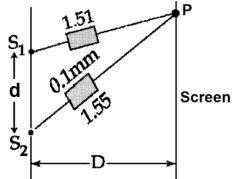
In Young's double slit experiment, two slits $S_1$ and $S_2$ are ' $d$ ' distance apart and the separation from slits to screen is $D$ (as shown in figure). Now if two transparent slabs of equal thickness $0.1\,mm$ but refractive index $1.51$ and $1.55$ are introduced in the path of beam $(\lambda=4000 \mathring A)$ from $S_1$ and $S_2$ respectively. The central bright fringe spot will shift by  $..........$ number of fringes.
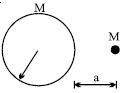
A particle of mass $M$ is at a distance a from surface of a thin spherical shell of equal mass and having radius a.
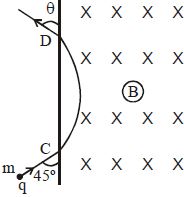
A particle of mass $m = 1.67 \times 10^{-27}\, kg$ and charge $q = 1.6 \times 10^{-19} \, C$ enters a region of uniform magnetic field of strength $1$ $tesla$ along the direction shown in the figure. The speed of the particle is $10^7\, m/s.$ The magnetic field is directed along the inward normal to the plane of the paper. The particle enters the field at $C$ and leaves at $D.$ Then the angle $\theta$ must be :-.........$^o$