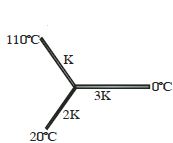
Three rods of equal length and cross sectional area and coefficient of thermal conductivities $K, 2K$ and $3K$ are joined as shown in figure temperature of their ends are $110\ ^oC, 20\ ^oC$ and $0\ ^oC$ respectively then temperature of junction will be ......... $^oC$
Medium


Download our appand get started for free
Experience the future of education. Simply download our apps or reach out to us for more information. Let's shape the future of learning together!No signup needed.*
Similar Questions
- 1A metallic sphere cools from $50^{\circ} C$ to $40^{\circ} C$ in $300 \,s.$ If atmospheric temperature around is $20^{\circ} C ,$ then the sphere's temperature after the next $5$ minutes will be close to$.....C$View Solution
- 2Two rods of same length and material transfer a given amount of heat in $12$ seconds, when they are joined end to end. But when they are joined lengthwise, then they will transfer same heat in same conditions in ....... $\sec$View Solution

- 3A solid sphere of radius $R$ and a hollow sphere of inner radius $r$ and outer radius $R$ made of copper are heated to the same temperature and are allowed to cool in the same environment. Then, choose the $CORRECT$ statementView Solution
- 4A black body radiates energy at the rate of $E$ $W/m^2$ at a high temperature $TK$ . When the temperature is reduced to $\frac{T}{2}K$, the radiant energy will beView Solution
- 5Two bottles $A$ and $B$ have radii $R_{A}$ and $R_{B}$ and heights $h_{A}$ and $h_{B}$ respectively, with $R_{B}=2 R_{A}$ and $h_{B}=2 h_{A}$. These are filled with hot water at $60^{\circ} C$. Consider that heat loss for the bottles takes place only from side surfaces. If the time, the water takes to cool down to $50^{\circ} C$ is $t_{A}$ and $t_{B}$ for bottles $A$ and $B$, respectively. Then, $t_{A}$ and $t_{B}$ are best related asView Solution
- 6View SolutionWhich of the following is the correct device for the detection of thermal radiation
- 7A cup of tea cools from $65.5^o C to 62.5 ^o C$ in one minute in a room of $22.5 ^o C$. How long will the same cup of tea take, in.............. minutes, to cool from $46.50^o C to 40.5 ^o C$ in the same room ? (choose nearest value)View Solution
- 8Wires $A$ and $B$ have identical lengths and have circular cross-sections. The radius of $A$ is twice the radius of $B$ $i.e.$ ${r_A} = 2{r_B}$. For a given temperature difference between the two ends, both wires conduct heat at the same rate. The relation between the thermal conductivities is given byView Solution
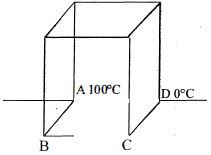
- 9Find Temperature difference between $B$ and $C$ ? (All rods are identical)View Solution
- 10A copper rod $2\,m$ long has a circular cross-section of radius $1\, cm$. One end is kept at $100^o\,C$ and the other at $0^o\,C$ and the surface is covered by nonconducting material to check the heat losses through the surface. The thermal resistance of the bar in degree kelvin per watt is (Take thermal conductivity $K = 401\, W/m-K$ of copper):-View Solution