MCQ
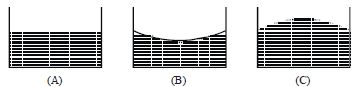
Three surfaces of liquid are shown here. Find the correct statements
  • A
    the surface tension of liquid $A$ is infinite and such a surface is not possible practically
  • B
    in case of liquid $B$ , the resultant force on a molecule on the surface would be downward, and the surface is concave
  • in case of liquid $C$ , the resultant force due to surface tension is directed downwards
  • D
    the surfaces of all three liquids $A, B$ and $C$ are in equilibrium and so the net force due to surface tension is the same

Answer

Correct option: C.
in case of liquid $C$ , the resultant force due to surface tension is directed downwards
c

Need a full question paper?

Generate a complete, print-ready paper with questions like this in minutes — across 16+ boards, with answer keys.

Start Generating Free

Similar questions

A mass of $1\, kg$ is hanging from a spring of spring constant $1\, N/m$. If Saroj pulls the mass down by $2\,m$. The work done by Saroj is......$J$
A wave travels uniformly in all directions from a point source in an isotropic medium. The displacement of the medium at any point at a distance $r$ from the source may be represented by ($A$ is a constant representing strength of source)
An engine takes in $5$ moles of air at $20\,^{\circ} C$ and $1$ $atm,$ and compresses it adiabaticaly to $1 / 10^{\text {th }}$ of the original volume. Assuming air to be a diatomic ideal gas made up of rigid molecules, the change in its internal energy during this process comes out to be $X\, kJ$. The value of $X$ to the nearest integer is
A ball of mass m moving with velocity in collides elastically with wall and rebounds. The change in momentum of the ball will be:
Average pressure pav is defined as:
Four particles $A, B, C, D$ of mass $\frac{\mathrm{m}}{2}, \mathrm{~m}, 2 \mathrm{~m}, 4 \mathrm{~m}$, have same momentum, respectively. The particle with maximum kinetic energy is:
A black body has maximum wavelength ${\lambda _m}$ at temperature $2000\; K$. Its corresponding wavelength at temperature $3000 \;K$ will be
Satellites orbiting the earth have finite life and sometimes debris of satellites fall to the earth. This is because,
  1. The solar cells and batteries in satellites run out.
  2. The laws of gravitation predict a trajectory spiralling inwards.
  3. Of viscous forces causing the speed of satellite and hence height to gradually decrease.
  4. Of collisions with other satellites.
A transverse wave is given by $y = A\sin 2\pi \left( {\frac{t}{T} - \frac{x}{\lambda }} \right)$. The maximum particle velocity is equal to $4$ times the wave velocity when
The velocity of the molecules of a gas at temperature 120K is v. At what temperature will the velocity be 2v?