Question
Three vertices of a rectangle $ABCD$ are $A(3, 1), B(-3, 1)$ and $C(-3, 3)$. plot these points on a graph paper and find the coordinates of the fourth vertex $D$. Also find the area of rectangle $ABCD$.

Answer

Let $A(3, 1), B(-3, 1)$ and $C(-3, 3)$ be three vertices of a rectangle $ABCD$.
 Let the $y$-axis cut the rectangle $ABCD$ at the points $P$ and $Q$ respectively. (Image)
Abscissa of $D$ = Abscissa of $A = 3.$
Ordinate of $D$ = ordinate of $C = 3.$
$\therefore$ coordinates of $D$ are $(3, 3). AB = (BP + PA) = (3 + 3)$ units $= 6$ units.
$BC = (OQ - OP) = (3 - 1)$ units$ = 2$ units.
$Ar($rectangle $ABCD) $
$= (AB \times BC) = (6 \times 2)$sq. units
$= 12$sq. units
Hence, the area of rectangle $ABCD$ $12$ square units.

Need a full question paper?

Generate a complete, print-ready paper with questions like this in minutes — across 16+ boards, with answer keys.
Start Generating Free

Similar questions

$ABCD$ is a rectangle in which diagonal $BD$ bisects $\angle\text{B}.$ Show that $ABCD$ is a square.
The perimeter of a triangle is $50\ cm$. One side of the triangle is $4\ cm$ longer than the smallest side and the third side is $6\ cm$ less than twice the smallest side. Find the area of the triangle.
If one of the four angles formed by two intersecting lines is a right angle, then show that each of the four angles is a right a angle.
A wooden bookshelf has external dimensions as follows: Height $= 110\ cm$, Depth $= 25\ cm,$ Breadth $= 85\ cm$ (See figure). The thickness of the plank is $5\ cm$ everywhere. The external faces are to be polished and the inner faces are to be painted. If the rate of polishing is $20$ paise per $cm^2$. Find the total expenses required for polishing and painting the surface of the bookshelf.
Give a method to find the centre of a given circle.
Find the area of a triangle two sides of which are 18cm and 10cm and the perimeter is 42cm.
$M$ is the mid-point of the side $AB$ of a parallelogram $ABCD$. If ar $(AMCD) = 24cm^2$, find $\text{ar}(\triangle\text{ABC}).$
Prove that the circles described with the four sides of a rhombus, as diameters, pass through the point of intersection of its diagonals.
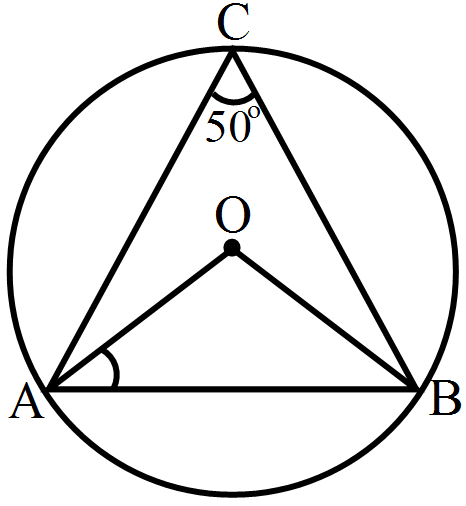
In the given figure, $O$ is the centre of the circle. If $\angle\text{ACB}=50^\circ,$ find $\angle\text{OAB}.$