Question
$[Ti(H_2O)]^{3+}$ is coloured while $[Sc(H_2O)_6]^{3+}$ is colourless.

Answer

This is due to d-d transition of electron in $[Ti(H_2O)]^{3+}$ complex $Ti^{3+}$ has one electron in d-orbital $(3d^1)$ which absorb energy corresponding to blue-green region and jumps from $t_{2g}$ to $e_g$ set of d-orbitals $\big(\text{t}^1_{2\text{g}}\text{ e}^0_{\text{g}}\xrightarrow{\ \ \ \ \ }\text{t}^0_{2\text{g}}\text{ e}^1_{\text{g}}\big).$ But $Sc^{3+}$​​​​​​​ has no electron in the d-orbital.

Need a full question paper?

Generate a complete, print-ready paper with questions like this in minutes — across 16+ boards, with answer keys.
Start Generating Free

Similar questions

The rate constant for the decomposition of hydrocarbons is $2.418 \times 10^{–5}s^{–1}$ at $546 K$. If the energy of activation is $179.9 kJ/mol$, what will be the value of pre-exponential factor.
What is the role of benzoyl peroxide in addition polymerisation of alkenes? Explain its mode of action with the help of an example.
Give the formula and describe the structure of a noble gas species which is isostructural with:
  1. ${ICl_4}^-$
  2. ${IBr_2}^-$
  3. ${BrO_3}^-$
  1. Based on the nature of intermolecular forces, classify the following solids:
Silicon carbide, Argon
  1. $ZnO$ turns yellow on heating. Why?
  2. What is meant by groups $12-16$ compounds? Give an example.
What happens when :
$(i)$ Acetic acid reacts with chlorine in the presence of red phosphorus?
$(ii)$ Silver acetate reacts with bromine in the presence of inert solvent $\left( CCl _4\right)$ ?
Give an example to show the effect of concentration of nitric acid on the formation of oxidation product.
Write one difference in each of the following:
  1. Write the dispersed phase and dispersion medium of milk.
  2. Write one similarity between physisorption and chemisorption.
  3. Write the chemical method by which $Fe(OH)_3$ sol is prepared from $FeCl_3.$
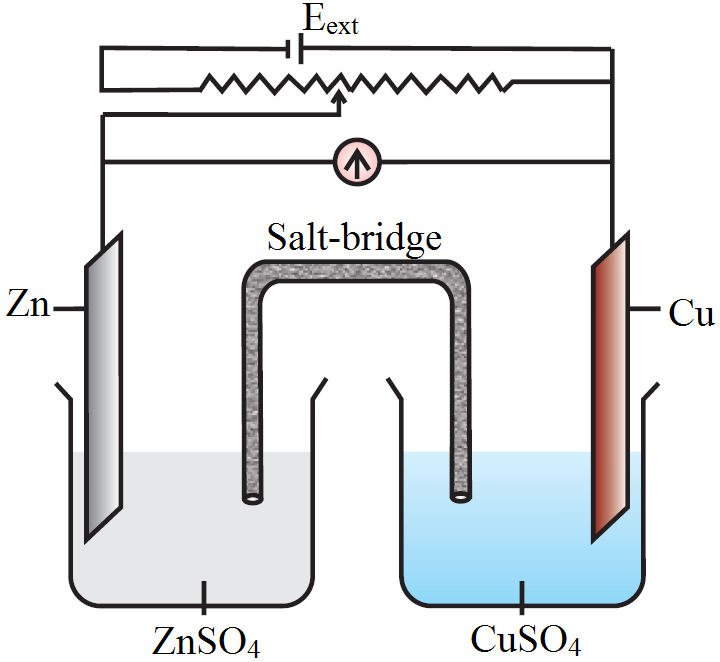
The electrochemical cell given alongside converts the chemical energy released during the redox reaction
$\text{Zn(s) + Cu}^{2+}\text{(aq)}\xrightarrow{ \ \ \ \ \ \ \ }\text{Zn}^{2+}(\text{aq) + Cu(s)}$
to electrical energy. It gives an electrical potential of $1.1V$ when concentration $Zn^{2+}$ and $Cu^{2+}$ ions is unity. State the direction of flow of current and also specify whether zinc and copper are deposited or dissolved at their respective electrodes when:
  1. An external opposite potential of less than $1.1V$ is applied.
  2. An external potential of $1.1V$ is applied.
  3. An external potential of greater than $1.1V$ is applied.
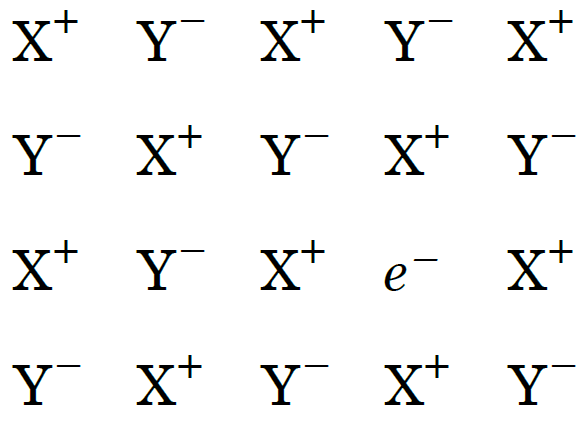
Examine the given defective crystal:
Answer the following questions:
  1. Is the above defect stoichiometric or non-stoichiometric?
  2. write the term used for the electron occupied site.
  3. Give an example of the compound which shows this type of defect.
Derive integrated rate equation for zero order reaction and also explain how the rate constant can be determine with help of graph.