MCQ
Time period of a simple pendulum will be double, if we
  • A
    Decrease the length 2 times
  • B
    Decrease the length 4 times
  • C
    Increase the length 2 times
  • Increase the length 4 times

Answer

Correct option: D.
Increase the length 4 times
d
(d)$T \propto \sqrt l $

Need a full question paper?

Generate a complete, print-ready paper with questions like this in minutes — across 16+ boards, with answer keys.
Start Generating Free

Similar questions

A bag of sand of mass $9.8\,kg$ is suspended by a rope. A bullet of $200 \,g$ travelling with speed $10\, ms ^{-1}$ gets embedded in it, then loss of kinetic energy will be $...J$
A train starting from rest first accelerates uniformly up to a speed of $80 \mathrm{~km} / \mathrm{h}$ for time $t$, then it moves with a constant speed for time 3t. The average speed of the train for this duration of journey will be (in $\mathrm{km} / \mathrm{h}$ ) :
The work done in pulling up a block of wood weighing $2 \,kN$ for a length of 10m on a smooth plane inclined at an angle of $15°$ with the horizontal is ............. $\mathrm{kJ}$
The total energy of a particle executing $S.H.M.$ is $80 \,J$. What is the potential energy when the particle is at a distance of $\frac{3}{4}$ of amplitude from the mean position..... $J$
The order of the magnitude of speed of light in $SI$ unit is ........ 
A 100 m long train is moving with a uniform velocity of $45 km / h$. The time taken by the train to cross a bridge of length 1 km is:
A piano string $1.5\,m$ long is made of steel of density $7.7 \times 10^3 \,kg/m^3$ and  Young’s modulus $2 \times 10^{11} \,N/m^2$. It is maintained at a tension which produces  an elastic strain of $1\%$ in the string. The fundamental frequency of transverse vibrations of string is ......... $Hz$
In a resonance tube the first resonance with a tuning fork occurs at $16 cm$ and second at $49 cm.$ If the velocity of sound is $330 m/s,$ the frequency of tuning fork is
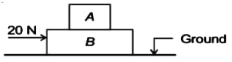
Blocks shown in figure moves with constant velocity $10 \,m / s$ towards right. All surfaces in contact are rough. The friction force applied by ground on block $B$ is ........ $N$
It is true for adiabatic change: