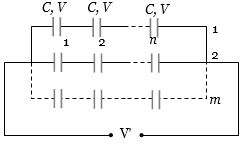
To form a composite $16\,\mu F,\;1000\,V$ capacitor from a supply of identical capacitors marked $8\,\mu F,\;250\,V$, we require a minimum number of capacitors
AIIMS 2000, Diffcult


Download our appand get started for free
Experience the future of education. Simply download our apps or reach out to us for more information. Let's shape the future of learning together!No signup needed.*
Similar Questions
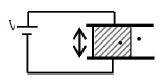
- 1A parallel plate capacitor, partially filled with a dielectric slab of dielectric constant $K$ , is connected with a cell of emf $V\ volt$ , as shown in the figure. Separation between the plates is $D$ . ThenView Solution
- 2View SolutionA capacitor is kept connected to the battery and a dielectric slab is inserted between the plates. During this process
- 3Two identical capacitors have same capacitance $C$. One of them is charged to the potential $\mathrm{V}$ and other to the potential $2 \mathrm{~V}$. The negative ends of both are connected together. When the positive ends are also joined together, the decrease in energy of the combined system is :View Solution
- 4$27$ identical drops are charged at $22\, V\,\,each.$ They combine to form a bigger drop. The potential of the bigger drop will be............ $V.$View Solution
- 5The plates of a parallel plate capacitor of capacity $50\,\mu C$ are charged to a potential of $100\;volts$ and then separated from each other so that the distance between them is doubled. How much is the energy spent in doing soView Solution
- 6The energy stored in the electric field produced by a metal sphere is $4.5\, J$. lf the sphere contains $4\,\mu C$ charge, its radius will be.......$mm$ : [Take : $\frac{1}{{4\pi {\varepsilon _0}}} = 9 \times {10^9}\,N - {m^2}\,/{C^2}\, ]$View Solution
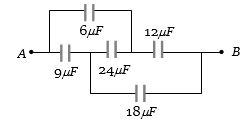
- 7In the connections shown in the adjoining figure, the equivalent capacity between $A$ and $B$ will be......$\mu F$View Solution
- 8A capacitor of capacitance $\mathrm{C}$ and potential $\mathrm{V}$ has energy $E$. It is connected to another capacitor of capacitance $2 \mathrm{C}$ and potential $2 \mathrm{~V}$. Then the loss of energy is $\frac{x}{3} E$, where $\mathrm{x}$ is____________.View Solution
- 9View SolutionConsider a neutral conducting sphere. A positive point charge is placed outside the sphere. The net charge on the sphere is then,
- 10A particle of charge $q$ and mass $m$ is subjected to an electric field $E = E _{0}\left(1- ax ^{2}\right)$ in the $x-$direction, where $a$ and $E _{0}$ are constants. Initially the particle was at rest at $x=0 .$ Other than the initial position the kinetic energy of the particle becomes zero when the distance of the particle from the origin isView Solution