MCQ
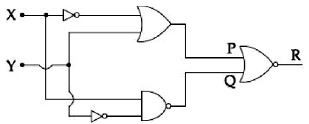
To get output ‘$1$’ at $R$, for the given logic gate circuit the input values must be
  • A
    $X = 0, Y = 1$
  • B
    $X = 1, Y = 1$
  • $X = 1, Y = 0$
  • D
    $X = 0, Y = 0$

Answer

Correct option: C.
$X = 1, Y = 0$
c
$\mathrm{R}=\overline{\mathrm{P}+\mathrm{Q}} $ $=\overline{(\bar{x}+y)+(\overline{x\bar{y}})}$

$=\overline{(\bar{x}+y)}\cdot (x\bar{y})$

$=(x \cdot \bar{y}) \cdot(x \bar{y})$

$=x \bar{y}$

Need a full question paper?

Generate a complete, print-ready paper with questions like this in minutes — across 16+ boards, with answer keys.
Start Generating Free

Similar questions

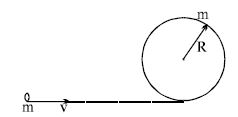
A circular hoop of mass $m$ and radius $R$ rests flat on a horizontal frictionless surface. A bullet, also of mass $m$ and moving with a velocity $v$ , strikes the hoop and gets embedded in it. The thickness of the hoop is much smaller than $R$ . The angular velocity with which the system rotates after the bullet strikes the hoop is 
The area of the triangle formed by $2\hat i + \hat j - \hat k$ and $\hat i + \hat j + \hat k$ is
A particle is oscillating according to the equation $X = 7\cos 0.5\pi t$, where $t$ is in second. The point moves from the position of equilibrium to maximum displacement in time  ..... $\sec$
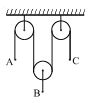
The pulleys in the diagram are all smooth and light. The acceleration of $A$ is a upwards and the acceleration of $C$ is $f$ downwards. The acceleration of $B$ is
Match List$-I$ with List$-II:$

List$-I$ List$-II$
$(A)$ $3$ Translational degrees of freedom $(I)$ Monoatomic gases
$(B)$ $3$ Translational,$2$ rotational degrees of freedoms $(II)$ Polyatomic gases
$(C)$ $3$ Translational,$2$ rotational and $1$ vibrational degrees of freedom $(III)$ Rigid diatomic gases
$(D)$ $3$ Translational,$3$ rotational and more than one vibrational degrees of freedom $(IV)$ Nonrigid diatomic gases

Choose the correct answer from the options given below:
A $10\, kW$ transmitter emits radio waves of wavelength $500\, m$. The number of photons emitted per second by the transmitter is of the order of
The energy required to take a satellite to a height $‘h’$ above Earth surface (radius of Earth $= 6.4 \times 10^3\,km$ ) is $E_1$ and kinetic energy required for the satellite to be in a circular orbit at this height is $E_2.$ The value of $h$ for which $E_1$ and $E_2$ are equal is
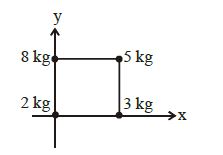
Four bodies of masses $2, 3, 5$ and $8\,kg$ are placed at the four corners of a square of side $2\,m$ as shown. The position of $CM$ will be
Two coils $X$ and $Y$ are placed in a circuit such that when a current changes $2A$ in coil $X,$ the magnetic flux changes by $0.4\,weber$ in $Y$. The value of mutual inductance of the coils....$H$
Given that; $A = B = C$. If $\vec A + \vec B = \vec C,$ then the angle between $\vec A$ and $\vec C$ is $\theta _1$. If $\vec A + \vec B+ \vec C = 0,$ then the angle between $\vec A$ and $\vec C$ is $\theta _2$. What is the relation between $\theta _1$ and $\theta _2$ ?