Question
Total internal reflection can take place only if:
  1. Light goes from optically rarer medium (smaller refractive index) to optically denser medium.
  2. Light goes from optically denser medium to rarer medium.
  3. The refractive indices of the two media are close to each other.
  4. The refractive indices of the two media are widely different.
Answer

  1. Light goes from optically denser medium to rarer medium.

Explanation:

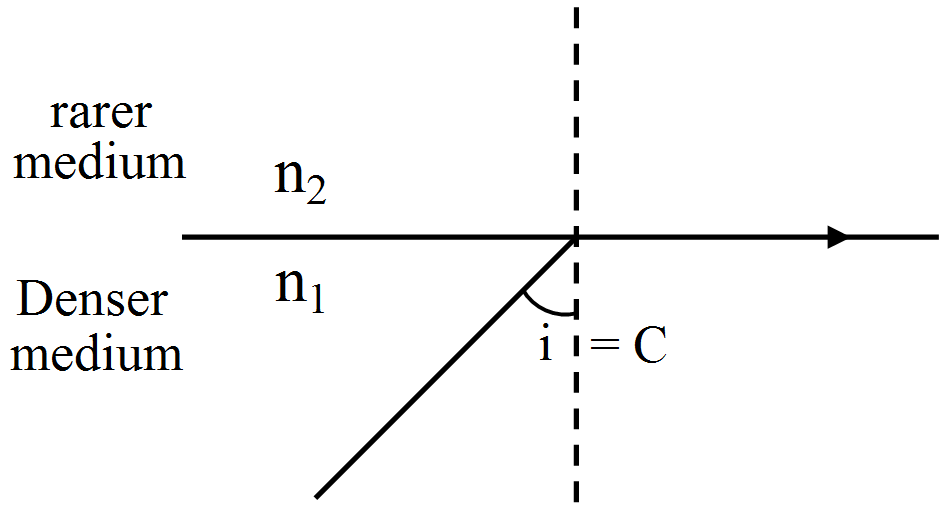
T.I.R. (Total Internal reflection)

i < C (condition for T.I.R.)

By Snell's Law

$\text{n}_1\sin\text{i}=\text{n}_2\sin90^{\circ}$

$\sin\text{i}=\frac{\text{n}_2}{\text{n}_1}=\sin\text{C}$

$\text{þ} \ \text{C}=\sin^{-1}$

$\because \ -1\leq\sin\text{i}\leq1$

n1 > n2 (so we can conclude that light goes from optically denser medium to rarer medium & incident angle is greater than the critical angle.)

Need a full question paper?

Generate a complete, print-ready paper with questions like this in minutes — across 16+ boards, with answer keys.

Start Generating Free

Similar questions

A helicopter reises from rest on the ground vertically upwards with a constant acceleration $g.$ A food packet is dropped from the helicopter when it is a height $h$. The time taken by the packet to reach the ground is close to $[ g$ is the acceleration due to gravity]
If vm is the velocity of sound in moist air, vd is the velocity of sound in dry air, under identical conditions of pressure and temperature
Two blocks $A$ and $B$ each of mass m are connected by a massless spring of natural length L and spring constant $K$. The blocks are initially resting on a smooth horizontal floor with the spring at its natural length as shown in figure. A third identical block $C$ also of mass $m$ moves on the floor with a speed $v$ along the line joining $A$ and $B$ and collides with $A$. Then
$A$ weightless rod is acted on by upward parallel forces of $2N$ and $4N$ ends $A$ and $B$ respectively. The total length of the rod $AB = 3m$. To keep the rod in equilibrium a force of $6N$ should act in the following manner:
The density of a cube is measured by measuring its mass and the length of its sides. If the maximum error in the measurement of mass and length are $3\%$ and $2\%$ respectively, then find the maximum error in the measurement of the density of cube.......... $\%$
The dimensions of thermal resistance are
A particle of mass $m$ strikes elastically on a wall with velocity $v$, at an angle of $60^{\circ}$ from the wall then magnitude of change in momentum of ball along the wall is
If, in the following diagram, distance between each circle is 1 unit, what is the displacement between A and B?

Two waves are represented by the equations : $y_1 = a\, sin\,(\omega t + kx + 0.57)\, m$ and $y_2 = a\, cos\,(\omega t + kx)\, m$, where $x$ is in $metres$ and $t$ is in $seconds$ . The phase difference between them is ..... $radian$
A hollow sphere is fitted with water through a small hole in it. It is then hung by a long thread and made to oscillate. As the water slowly flows out of the hole at the bottom, the period of oscillation will: