Question
Transition metals and their many compounds act as good catalyst. Give reason.

Answer

a. The ability of transition metal ion to pass easily from one oxidation state to another and thus providing a new path to reaction with lower activation energy.
b. The surface of transition metal acts as very good adsorbent and thus provides increased concentration of reactants on their surface causing the reaction to occur.

Need a full question paper?

Generate a complete, print-ready paper with questions like this in minutes — across 16+ boards, with answer keys.
Start Generating Free

Similar questions

Write the mechanism of acid dehydration of ethanol to give ethene.
Comment on the statement that elements of the first transition series possess many properties different from those of heavier transition elements.
(a) Out of the following pairs, predict with reason which pair will allow greater conduction electricity:
(i) Silver wire at $30^{\circ}C$ or silver wire at $60^{\circ}C.$
(ii) 0.1 M $CH_{3}COOH$ solution or 1 M $CH_{3}COOH$ solution.
(iii) KCl solution at $20^{\circ}C$ or KCl solution at $50^{\circ}C$.
(b) Give two points of differences between electrochemical and electrolytic cells.
Give equations for the following reactions :
(i) Oxidation of propan-1-ol with alkaline $KMnO _4$ solution.
(ii) Bromine in presence of $C S _{ 2 }$ with phenol.
(iii) Dilute nitric acid with phenol.
The d-block of the periodic table contains the elements of the groups 3 to 12 and are known as transition elements. In general, the electronic configuration of these elements is $(n-1) d^{1-10} n s^{1-2}$. The d-orbitals of the penultimate energy level in their atoms receive electrons giving rise to the three rows of the transition metals i.e. 3d, 4d and 5d series. However, $Zn , Cd$ and Hg are not regarded as transition elements. Transition elements exhibit certain characteristic properties like variable oxidation stables, complex formation, formation of coloured ions, alloys, catalytic activity etc. Transition metals are hard (except $Zn , Cd$ and Hg ) and have a high melting point.
i. Why are $Zn , Cd$ and Hg non-transition elements?
ii. Which transition metal of 3d series does not show variable oxidation state?
iii. Why do transition metals and their compounds show catalytic activity?
OR
iii. Why are melting points of transition metals high?
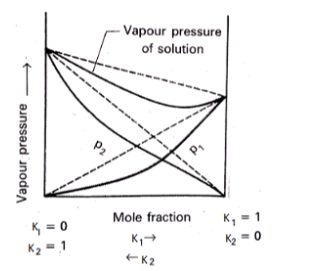
Read the following text carefully and answer the questions that follow: Raoult's law states that for a solution of volatile liquids, the partial vapour pressure of each component of the solution is directly proportional to its mole fraction present in solution.
Dalton's law of partial pressure states that the total pressure $(P_{total})$ over the solution phase in the container will be the sum of the partial pressures of the components of the solution and is given as: $P_{total} = P1 + P2$
Image
i. Is the above $-$ mentioned Raoult's law applicable for non $-$ volatile liquids?
ii. What type of deviation from Raoult's law does the above graph represent?
iii. Give an example of such system.
$OR$
iii. A solution of two liquids boils at a temperature more than the boiling point of either of them. What type of deviation will be shown by the solution formed in terms of Raoult's law?
Why Haloarenes are less reactive towards nucleophilic substitution reactions. Give reasons.
Draw the shape of the following molecules :
(1) $XeOF _4$
(2) $B r F _3$
(3) $HClO _4$
(4) $XeF _2$
Write down the preparation of alkyl halides from alcohols.
The rate constant for the first order decomposition of $H_{2}O_{2}$ is given by the following equation: $log~k=14.2-\frac{1.0\times10^{4}K}{T}$. Calculate $E_a$ for this reaction and rate constant k if its half-life period be 200 minute.
( given $R =8.314 J K ^{-1} mol^{-1}$)