MCQ
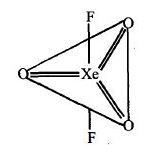
Trigonal bipyramidal geometry is shown by
  • A
    $XeOF_2$
  • $XeO_3F_2$
  • C
    $FXeOSO_2F$
  • D
    $[XeF_8]^{2-}$

Answer

Correct option: B.
$XeO_3F_2$
b
The hybridization of $XeO_3F_2$ is $sp^3d$ and its structure is trigonal bipyramidal in which oxygen atoms are situated on the plane and the fluoride atoms are on the top and bottom

Need a full question paper?

Generate a complete, print-ready paper with questions like this in minutes — across 16+ boards, with answer keys.

Start Generating Free

Similar questions

In the following reaction, $2H_2O_2 \to 2H_2O + O_2$ rate of formation of $O_2$ is $36\, g\, min^{-1}$, what is rate of disappearance of $H_2O_2$ in $(mol/min)$
Which of the following complex will show geometrical as well as optical isomerism?
A chemist has $4$ samples of artificial sweetner $A$. $\mathrm{B}, \mathrm{C}$ and $\mathrm{D}$. To identify these samples, he performed certain experiments and noted the following observations :

$(i)$ $A$ and $D$ both form blue-violet colour with ninhydrin.

$(ii)$ Lassaigne extract of $\mathrm{C}$ give  positive $\mathrm{AgNO}_{3}$ test and negative $\mathrm{Fe}_{4}\left[\mathrm{Fe}(\mathrm{CN})_{6}\right]_{3}$ test.

$(iii)$ Lassaigne extract of $\mathrm{B}$ and D gives positive sodium nitroprusside test

Based on these observations which option is correct ?

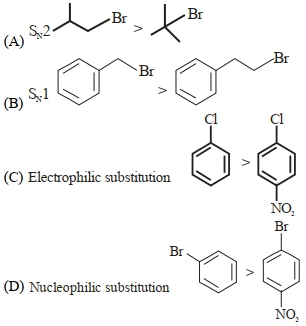
Identify the correct order of reactivity for the following pairs towards the respective mechanism

Choose the correct answer from the options given below:
$D-$ glucose & $D-$ fructose can be differentiated by
An organic compound $A$ on treatment with $NH_3$ gives $B,$ which on heating gives $C.\,\, C$ when treated with $Br_2$ in the presence of $KOH$ produces ethyl amine. Compound $A$ is
Which of the following reactions give $RCON{H_2}$
The osmotic pressure of a $5\%$  (wt/vol) solution of cane sugar at $150\,^oC$ is ......... $atm.$
Which of the following represent free radical substitution reaction $(FSR)$, electrophilic addition reaction $(EAR)$ and nucleophilic addition reaction $(NAR)$

$I.$ $CH_3 -CH = CH_2$ $\xrightarrow[{{\text{(CC}}{{\text{l}}_4}{\text{ )}}}]{{{\text{C}}{{\text{l}}_2}}}$ $\begin{array}{*{20}{c}}
{Cl\,\,}\\
{\,\,|\,\,\,\,\,}\\
{C{H_3} - CH - C{H_2}}\\
{\,\,\,\,\,\,\,\,\,\,\,\,\,\,\,\,\,\,\,\,\,\,\,\,\,\,|}\\
{\,\,\,\,\,\,\,\,\,\,\,\,\,\,\,\,\,\,\,\,\,\,\,\,\,\,\,Cl}
\end{array}$

$II.$ $\begin{array}{*{20}{c}}
O\\
{||}\\
{C{H_3} - C - C{H_3}}
\end{array}$ $\xrightarrow[{{}^\Theta OH}]{{{\text{HCN}}}}$ $\begin{array}{*{20}{c}}
{\,\,\,\,\,OH}\\
|\\
{C{H_3} - C - C{H_3}}\\
|\\
{\,\,\,\,\,CN}
\end{array}$

$III.$ $CH_3-CH_2-CH_3$ $\xrightarrow[{hv}]{{C{l_2}}}$ $\begin{array}{*{20}{c}}
{Cl\,\,}\\
{|\,\,\,\,}\\
{C{H_3} - CH - C{H_3}}
\end{array}$

When a solute is present in trace quantities the following expression is used: