MCQ
Tuning fork ${F_1}$ has a frequency of $256 Hz$ and it is observed to produce $6$ beats/second with another tuning fork ${F_2}$. When ${F_2}$ is loaded with wax, it still produces $6$ beats/second with ${F_1}$. The frequency of ${F_2}$ before loading was ..... $Hz$
  • A
    $253$
  • $262$
  • C
    $250 $
  • D
    $259$

Answer

Correct option: B.
$262$
b
(b) $n_A$ = Known frequency $= 256 Hz, n_B = ?$ 

$x = 6\, bps$, which remains the same after loading. 

Unknown tuning fork $F_2$ is loaded so $n_B\downarrow$ 

Hence $n_A -n_B\downarrow = x $... $(i)$ $\rightarrow$ Wrong

$n_B\downarrow -n_A = x$ ... $(ii)$ $\rightarrow$ Correct 

==> $n-B = n_A + x = 256 + 6 = 262 Hz.$

Need a full question paper?

Generate a complete, print-ready paper with questions like this in minutes — across 16+ boards, with answer keys.

Start Generating Free

Similar questions

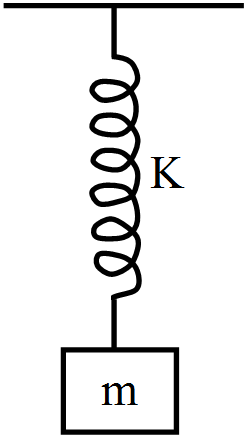
A block is left in the equilibrium position as shown in the figure.

If now it is stretched by $\frac{\text{mg}}{\text{k}}$, the net stretch of the spring is:
At constant volume, temperature is increased. Then
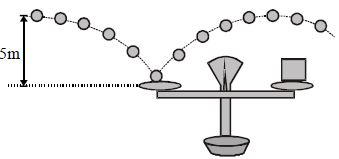
A stream of glass beads, each with a mass of $15\  gram$, comes out of a horizontal tube at a rate of $100\  per second$. The beads fall a distance of $5\  m$ to a balance pan and bounce back to their original height. How much mass(in $kg$) must be placed in the other pan of the balance to keep the pointer at zero?
A transverse wave of frequency $500 \,Hz$ and speed $100 \,m / s$ is travelling in the positive $x$-direction on a long string. At time $t=0 \,s$, the displacements at $x=0.0 \,m$ and at $x=0.25 \,m$ are $0.0 \,m$ and $0.02 \,m$, respectively. The displacement at $x=0.2 \,m$ at $t=5 \times 10^{-4} s$ is ............ $m$
$A$ body kept on a smooth horizontal surface is pulled by a constant horizontal force applied at the top point of the body. If the body rolls purely on the surface, its shape can be : 
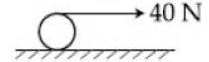
A string is wound around a hollow cylinder of mass $5\, kg$ and radius $0.5\,m$. If the string is now pulled with a horizontal force of $40\, N$, and the cylinder is rolling without slipping on a horizontal surface (see figure), then the angular acceleration of the cylinder will be ......... $rad/s^2$ .(Neglect the mass and thickness of the string)
Shearing stress causes change in
A wire elongates by $l$ $mm$ when a load $W$ is hanged from it. If the wire goes over a pulley and two weights $W$ each are hung at the two ends, the elongation of the wire will be (in $mm$)
Two waves represented by $\text{y}=\text{a}\sin(\omega\text{t}-\text{kx})$ and $\text{y}=\text{a}\cos(\omega\text{t}-\text{kx})$ are superposed. The resultant wave will have an amplitude:
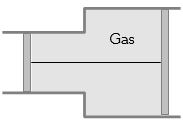
A gas is filled in the cylinder shown in the figure. The two pistons are joined by a string. If the gas is heated, the pistons will