Twenty seven drops of same size are charged at $220\, \mathrm{~V}$ each. They combine to form a bigger drop. Calculate the potential of the bigger drop. (In $\mathrm{~V}$)
NEET 2021, Medium


Download our appand get started for free
Experience the future of education. Simply download our apps or reach out to us for more information. Let's shape the future of learning together!No signup needed.*
Similar Questions
- 1A parallel plate capacitor has $1\,\mu F$ capacitance. One of its two plates is given $+2\,\mu C$ charge and the other plate, $+4\,\mu C$ charge. The potential difference developed across the capacitor is......$V$View Solution
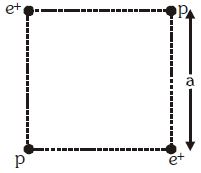
- 2Two positrons $(e^+)$ and two protons $(p)$ are kept on four corners of a square of side $a$ as shown in figure. The mass of proton is much larger than the mass of positron. Let $q$ denotes the charge on the proton as well as the positron then the kinetic energies of one of the positrons and one of the protons respectively after a very long time will be-View Solution
- 3A capacitor of capacitance $C$ is charged to potential difference $V_0$. Now this capacitor is connected to an ideal inductor. When $25\%$ of energy of capacitor is transferred to inductor then at that time what will be potential difference across capacitorView Solution
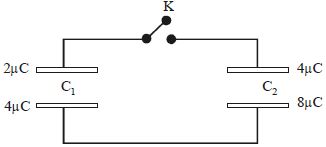
- 4Assertion : Charges are given to plates of two plane parallel plate capacitors $C_1$ and $C_2$ (such that $C_2 = 2C_1$ ) as shown in figure. Then the key $K$ is pressed to complete the circuit. Finally the net charge on upper plate and net charge the circuit. Finally the net charge on upper plate and net charge on lower plate of capacitor $C_1$ is positive.View Solution
Reason : In a parallel plate capacitor both plates always carry equal and opposite charge.
- 5If there are $n$ capacitors in parallel connected to $V$ volt source, then the energy stored is equal toView Solution
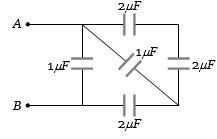
- 6The total capacity of the system of capacitors shown in the adjoining figure between the points $A$ and $B$ is.....$\mu F$View Solution
- 7Two parallel plate condensers of capacity of $20 \mu F$ and $30 \mu F$ are charged to the potentials of $30V$ and $20V$ respectively. If likely charged plates are connected together then the common potential difference will be :-......$V$View Solution
- 8View SolutionHydrogen ion and singly ionized helium atom are accelerated, from rest, through the same potential difference. The ratio of final speeds of hydrogen and helium ions is close to......
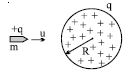
- 9A bullet of mass $m$ and charge $q$ is fired towards a solid uniformly charged sphere of radius $R$ and total charge $+ q$. If it strikes the surface of sphere with speed $u$, find the minimum speed $u$ so that it can penetrate through the sphere. (Neglect all resistance forces or friction acting on bullet except electrostatic forces)View Solution
- 10A thin spherical insulating shell of radius $R$ carries a uniformly distributed charge such that the potential at its surface is $V _0$. A hole with a small area $\alpha 4 \pi R ^2(\alpha<<1)$ is made on the shell without affecting the rest of the shell. Which one of the following statements is correct?View Solution