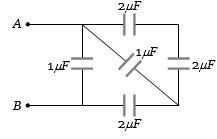
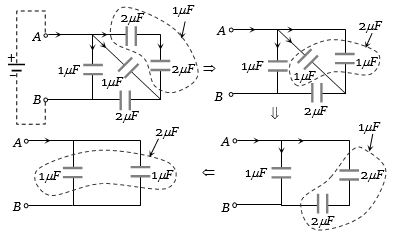
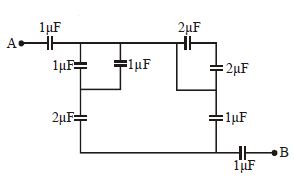
The total capacity of the system of capacitors shown in the adjoining figure between the points $A$ and $B$ is.....$\mu F$
Medium


Download our appand get started for free
Experience the future of education. Simply download our apps or reach out to us for more information. Let's shape the future of learning together!No signup needed.*
Similar Questions
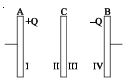
- 1Plates $A$ and $B$ constitute an isolated, charge parallel-plate capacitor. The inner surfaces ($I$ and $IV$) of $A$ and $B$ have charges $+Q$ and $-Q$ respectively. Athird plate $C$ with charge $+$$Q$ is now introduced midway between $A$ and $B$. Which of the following statements is not correct?View Solution
- 2View SolutionWhen we touch the terminals of a high voltage capacitor, even after a high voltage has been cut off, then the capacitor has a tendency to
- 3Find the equivalent capacitance between $A$ and $B$View Solution
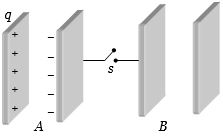
- 4Consider the situation shown in the figure. The capacitor $A$ has a charge $q$ on it whereas $B$ is uncharged. The charge appearing on the capacitor $B$ a long time after the switch is closed isView Solution
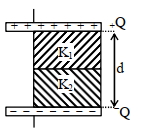
- 5A parallel - plate capacitor with plate area $A$ has separation $d$ between the plates. Two dielectric slabs of dielectric constant ${K}_{1}$ and ${K}_{2}$ of same area $\frac A2$ and thickness $\frac d2$ are inserted in the space between the plates. The capacitance of the capacitor will be given by :View Solution
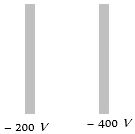
- 6Two identical positive charges are placed at $x =\, -a$ and $x = a$ . The correct variation of potential $V$ along the $x-$ axis is given byView Solution
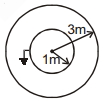
- 7Figure shows a solid conducting sphere of radius $1 m$, enclosed by a metallic shell of radius $3 \,m$ such that their centres coincide. If outer shell is given a charge of $6 \,\mu C$ and inner sphere is earthed, find magnitude charge on the surface of inner shell is ............. $\mu C$View Solution
- 8Two tiny electric dipoles of dipole moment $P_1$ and $P_2$ are placed $'r'$ distance coaxially find magnitude of electrostatic force between them.View Solution
- 9$n$ identical condensers are joined in parallel and are charged to potential $V$. Now they are separated and joined in series. Then the total energy and potential difference of the combination will beView Solution
- 10View SolutionIn the following figure two parallel metallic plates are maintained at different potential. If an electron is released midway between the plates, it will move