Twenty seven drops of water of the same size are equally and similarly charged. They are then united to form a bigger drop. By what factor will the electrical potential changes.........$times$
Easy
Download our app for free and get started
(a) ${V_{Big}} = {n^{2/3}}.{v_{small}}$ $==>$ ${V_{Big}} = {(27)^{2/3}}.{v_{small}} = 9\,{v_{small}}$

Download our appand get started for free
Experience the future of education. Simply download our apps or reach out to us for more information. Let's shape the future of learning together!No signup needed.*
Similar Questions
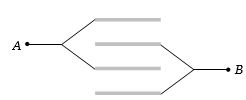
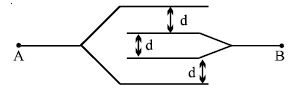
- 1Four plates of the same area of cross-section are joined as shown in the figure. The distance between each plate is $d$. The equivalent capacity across $A$ and $B$ will beView Solution
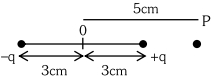
- 2An electric dipole is placed as shown in the figure.The electric potential (in $10^2\,V$ ) at point $P$ due to the dipole is $\left(\in_0=\right.$ permittivity of free space and $\left.\frac{1}{4 \pi \in_0}=K\right)$ :View Solution
- 3View SolutionA long, hollow conducting cylinder is kept coaxially inside another long, hollow conducting cylinder of larger radius. Both the cylinders are initially electrically neutral.
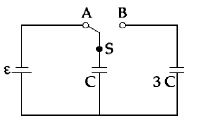
- 4This questions has statement$-1$ and statement$-2$. Of the four choices given after the statements, choose the one that best describe the two statements.View Solution
An insulating solid sphere of radius $R$ has a uniformly
positive charge density $\rho$. As a result of this uniform charge distribution there is a finite value of electric potential at the centre of the sphere, at the surface of the sphere and also at a point out side the sphere. The electric potential at infinite is zero.Statement$ -1$ : When a charge $q$ is take from the centre of the surface of the sphere its potential energy changes by $\frac{{q\rho }}{{3{\varepsilon _0}}}$
Statement$ -2$ : The electric field at a distance $r(r < R)$ from centre of the sphere is $\frac{{\rho r}}{{3{\varepsilon _0}}}$
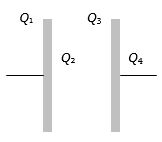
- 5In an isolated parallel plate capacitor of capacitance $C$, the four surface have charges ${Q_1}$, ${Q_2}$, ${Q_3}$ and ${Q_4}$ as shown. The potential difference between the plates isView Solution
- 6Four metallic plates arearranged as shown in the figure. If the distance between each plate then capacitance of the given system between points $A$ and $B$ is (Given $d < < A$)View Solution
- 7View SolutionThe ratio of charge to potential of a body is known as
- 8If identical charges $( - q)$ are placed at each corner of a cube of side $b$, then electric potential energy of charge $( + q)$ which is placed at centre of the cube will beView Solution
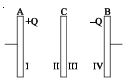
- 9Plates $A$ and $B$ constitute an isolated, charge parallel-plate capacitor. The inner surfaces ($I$ and $IV$) of $A$ and $B$ have charges $+Q$ and $-Q$ respectively. Athird plate $C$ with charge $+$$Q$ is now introduced midway between $A$ and $B$. Which of the following statements is not correct?View Solution
- 10In the figure shown, after the switch $‘S’$ is turned from position $‘A’$ to position $‘B’$, the energy dissipated in the circuit in terms of capacitance $‘C’$ and total charge $‘Q’$ isView Solution