Two batteries of different $e.m.f.'s$ and internal resistance connected in series with each other and with an external load resistor. The current is $3.0 \,A$. When the polarity of one battery is reversed, the current becomes $1.0 \,A$. The ratio of the $e.m.f.'s$ of the two batteries is ............
Medium
Download our app for free and get started
(b)
$3=\frac{E_1+E_2}{R+r_1+r_2}$
$1=\frac{E_1-E_2}{R+r_1+r_2}$
$3=\frac{E_1+E_2}{E_1-E_2}$
$2=\frac{E_1}{E_2}$

Download our appand get started for free
Experience the future of education. Simply download our apps or reach out to us for more information. Let's shape the future of learning together!No signup needed.*
Similar Questions
- 1View SolutionWhich of the following is not equal to watt
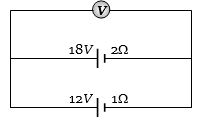
- 2Two batteries, one of emf $18\,volts\;emf$ and internal resistance $2\,\Omega $ and the other of emf $12\, volt$ and internal resistance $1\,\Omega $, are connected as shown. The voltmeter $V$ will record a reading of .............. $volt$View Solution
- 3View SolutionWhen current flows through a conductor, then the order of drift velocity of electrons will be
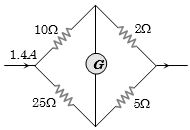
- 4In the circuit shown in the figure, the current flowing in $2\,\Omega $ resistance ............... $A$View Solution
- 5The terminal voltage across a battery of $\mathrm{emf}$ $E$ can beView Solution
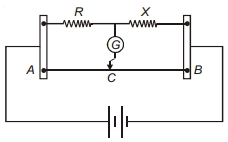
- 6In the meter bridge shown, the resistance $X$ has a negative temperature coefficient of resistance. Neglecting the variation in other resistors, when current is passed for some time, in the cirucit, balance point should shift towards.View Solution
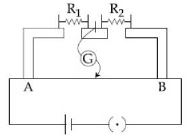
- 7In the experimental setup of meter bridge shown in the figure, the null point is obtained at a distance of $40\,cm$ from $A$. If a $10\,\Omega $ resistor is connected in series with $R_1$, the null point shifts by $10\,cm$. The resistance that should be connected in parallel with $\left( {{R_1} + 10} \right)\,\Omega $ such that the null point shifts back to its initial position is .............. $\Omega$View Solution
- 8Calculate the amount of charge flowing in $2$ minutes in a wire of resistance $10$ $\Omega$ when a potential difference of $20\,V$ is applied between its ends ............ $C$View Solution
- 9The equivalent resistance and potential difference between $A$ and $B$ for the circuit is respectivelyView Solution
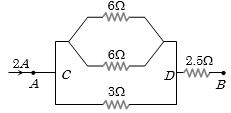
- 10The combination of two identical cells, whether connected in series or parallel combination provides the same current through an external resistance of $2 \,\Omega$. The value of internal resistance of each cell is ............ $\Omega$View Solution