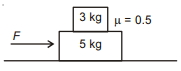
Two blocks $A$ and $B$ of masses $5 \,kg$ and $3 \,kg$ respectively rest on a smooth horizontal surface with $B$ over $A$. The coefficient of friction between $A$ and $B$ is $0.5$. The maximum horizontal force (in $kg$ wt.) that can be applied to $A$, so that there will be motion of $A$ and $B$ without relative slipping, is
Medium


Download our appand get started for free
Experience the future of education. Simply download our apps or reach out to us for more information. Let's shape the future of learning together!No signup needed.*
Similar Questions
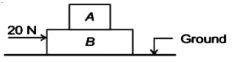
- 1Blocks shown in figure moves with constant velocity $10 \,m / s$ towards right. All surfaces in contact are rough. The friction force applied by $B$ on $A$ is ...........$N$View Solution
- 2The force required just to move a body up an inclined plane is double the force required just to prevent the body sliding down. If the coefficient of friction is $0.25$, the angle of inclination of the plane is ...... $^o$View Solution
- 3View SolutionWhich of the following statements is not true
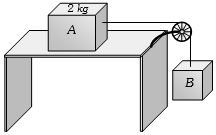
- 4The coefficient of static friction, ${\mu _s},$ between block $A$ of mass $2\, kg$ and the table as shown in the figure is $0.2$. ........ $kg$ would be the maximum mass value of block $B$ so that the two blocks do not move. The string and the pulley are assumed to be smooth and massless. $(g = 10\,m/{s^2})$View Solution
- 5A mass is supported on a frictionless horizontal surface. It is attached to a string and rotates about a fixed centre at an angular velocity ${\omega _0}$. If the length of the string and angular velocity are doubled, the tension in the string which was initially ${T_0}$ is nowView Solution
- 6In figure, two blocks $M$ and $m$ are tied together with an inextensible and light string. The mass $M$ is placed on a rough horizontal surface with coefficient of friction $\mu$ and the mass $m$ is hanging vertically against a smooth vertical wall. The pulley is frictionless. When the downward acceleration of the elevator becomes equal to $g$, thenView Solution

- 7A block rests on a rough inclined plane making an angle of $30^o$ with the horizontal. The coefficient of static friction between the block and the plane is $0.8.$ If the frictional force on the block is $10\, N$, the mass of the block (in $kg$) is : (taken $g = 10 \,m/s^2)$View Solution
- 8$Assertion$ : Angle of repose is equal to the angle of limiting friction.View Solution
$Reason$ : When the body is just at the point of motion, the force of friction in this stage is called limiting friction. - 9View SolutionA metal block is resting on a rough wooden surface. A horizontal force applied to the block is increased uniformly. Which of the following curves correctly represents velocity of the block ?
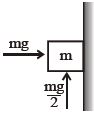
- 10View SolutionA block pressed against the vertical wall is in equilibrium. The minimum coefficient of friction is:-