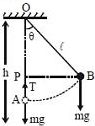
A pendulum consisting of a small sphere of mass $m$ suspended by an inextensible and massless string of length $l$ is made to swing in a vertical plane. If the breaking strength of the string is $2mg$ , then the maximum angular amplitude of the displacement from the vertical can be ....... $^o$
Diffcult


Download our appand get started for free
Experience the future of education. Simply download our apps or reach out to us for more information. Let's shape the future of learning together!No signup needed.*
Similar Questions
- 1To double the length of a iron wire having $0.5\,c{m^2}$ area of cross-section, the required force will be $(Y = {10^{12}}\,dyne/c{m^2})$View Solution
- 2A wire of length $L$ and radius $r$ is clamped at one end. If its other end is pulled by a force $F$, its length increases by $l$. If the radius of the wire and the applied force both are reduced to half of their original values keeping original length constant, the increase in length will become.View Solution
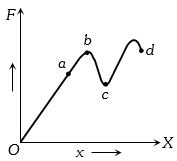
- 3The graph is drawn between the applied force $F$ and the strain $(x)$ for a thin uniform wire. The wire behaves as a liquid in the partView Solution
- 4A steel wire of lm long and $1\,m{m^2}$ cross section area is hang from rigid end. When weight of $1\,kg$ is hung from it then change in length will be given ..... $mm$ $(Y = 2 \times {10^{11}}N/{m^2})$View Solution
- 5In steel, the Young's modulus and the strain at the breaking point are $2 \times {10^{11}}\,N{m^{ - 2}}$ and $0.15$ respectively. The stress at the breaking point for steel is thereforeView Solution
- 6A wire of length $L$ and radius $r$ is clamped rigidly at one end. When the other end of the wire is pulled by a force $F$, its length increases by $5\,cm$. Another wire of the same material of length $4 L$ and radius $4\,r$ is pulled by a force $4\,F$ under same conditions. The increase in length of this wire is $....cm$.View Solution
- 7A wire of area of cross-section $10^{-6}\,m^2$ is increased in length by $0.1\%$. The tension produced is $1000\, N$. The Young's modulus of wire isView Solution
- 8A wire of area of cross-section ${10^{ - 6}}{m^2}$ is increased in length by $0.1\%$. The tension produced is $1000 N$. The Young's modulus of wire isView Solution
- 9Join details of Column$-II$ with given information in Column$-I$ appropriatelyView Solution
Column $-I$ Column $-II$ $(a)$ Stress is proportional to strain.
$(i)$ Elastic limit $(b)$ When the load of the wire is removed, the body does regain its original dimension. $(ii)$ Limit of pro-portionality $(iii)$ Plastic deformation - 10View SolutionTwo identical wires of rubber and iron are stretched by the same weight, then the number of atoms in the iron wire will be