MCQ
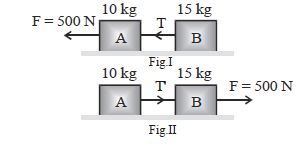
Two bodies $A$ and $B$ of masses $10\,\, kg$ and $15\, kg$ respectively kept on a smooth, horizontal surface are tied to the ends of a light string. If $T$ represents the tension in the string when a horizontal force $F = 500\, N$ is applied to $A$ (as shown in figure $1$) and $T'$ be the tension when it is applied to $B$ (figure $2$), then which of the following is true
  • A
    $T=T' = 500\, N$
  • B
    $T = T' = 250\, N$
  • C
    $T = 200\, N, T' = 300\, N$
  • $T = 300\, N, T' = 200\, N$

Answer

Correct option: D.
$T = 300\, N, T' = 200\, N$
d
Acceleration $=\frac{500}{25}=20 m / s^{2}$ in both the cases.

In fig $1, T=500-10 \times 20=300 N$

In fig $2, T=500-15 \times 20=200 N$

Need a full question paper?

Generate a complete, print-ready paper with questions like this in minutes — across 16+ boards, with answer keys.

Start Generating Free

Similar questions

A Carnot engine has efficiency $25\%$ . It operates between reservoirs of constant temperature with temperature difference of $80\,K$ . What is the temperature of low temperature reservoir ...... $^oC$
The phase difference between two waves, represented by
$
\begin{aligned}
& y_1=10^{-6} \sin \left[100 t+\left(\frac{x}{50}\right)+0.5\right] m \\
& y_2=10^{-6} \cos \left[100 t+\left(\frac{x}{50}\right)\right] m
\end{aligned}
$
where x is expressed in metres and $t$ is expressed in seconds, is approximately
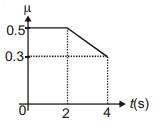
A block is projected with speed $20 \,m / s$ on a rough horizontal surface. The coefficient of friction $(\mu)$ between the surfaces varies with time $(t)$ as shown in figure. The speed of body at the end of $4$ second will be ............ $m / s$ ( $g=$ $10 \,m / s ^2$ )
Two bodies of different masses ${m_a}$ and ${m_b}$ are dropped from two different heights $a$ and $b$. The ratio of the time taken by the two to cover these distances are
What is the angle between $(\overrightarrow P + \overrightarrow Q )$ and $(\overrightarrow P \times \overrightarrow Q )$
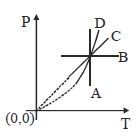
Following figure shows $P-T$ graph for four processes $A, B, C$ and $D$. Select the correct alternative
The value of the radius of gyration of a body does not depend on:
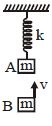
Block $A$ is hanging from a vertical spring and it is at rest. Block $'B'$ strikes the block $'A'$ with velocity $v$ and stick to it. Then the velocity $v$ for which the spring just attains natural length is:
The displacement of a particle in $\text{SHM}$ varies according to the relation $\text{x}=4(\cos\pi\text{t}+\sin\pi\text{t})$ The amplitude of the particle is:
A particle is moving with uniform speed along the circumference of a circle of radius $R$ under the action of a central fictitious force $F$ which is inversely proportional to $R ^{3}$. Its time period of revolution will be given by