MCQ
Two bodies having volumes $V$ and $2V $ are suspended from the two arms of a common balance and they are found to balance each other. If larger body is immersed in oil (density $d_1 $ $=$ $ 0.9$ $ gm/cm^3$) and the smaller body is immersed in an unknown liquid, then the balance remain in equilibrium. The density of unknown liquid is given by ......... $gm/cm^3$
  • A
    $2.4$
  • $1.8$
  • C
    $0.45 $
  • D
    $2.7$

Answer

Correct option: B.
$1.8$
b
Two bodies are found to balance each other even after these are dipped is liquids of different densities,

 which means they have displaced the equal weights of liquids.

Weight of the oil displaced by larger block $=2 V \times 0.9 \times g$  $...(I)$

Weight of the unknown liquid displaced by smaller block $=V \times \rho \times g$ $...(II)$

Equating $(I)$ and $(I I),$ we have

$\rho=1.8 \mathrm{gm} / \mathrm{cm}^{3}$

Need a full question paper?

Generate a complete, print-ready paper with questions like this in minutes — across 16+ boards, with answer keys.

Start Generating Free

Similar questions

A thin uniform cylindrical shell, closed at both ends, is partially filled with water. It is floating vertically in water in half-submerged state. If $\rho_0$ is the relative density of the material of the shell with respect to water, then the correct statement is that the shell is
A light string fixed at one end to a clamp on ground passes over a fixed pulley and hangs at the other side. It makes an angle of $30^o$ with the ground. A monkey of mass $5\ kg$ climbs up the rope. The clamp can tolerate a vertical force of $40\ N$ only. The maximum acceleration in upward direction with which the monkey can climb safely is ............ $m/s^2$ (neglect friction and take $g = 10\ m / s^2$ )
A particle of mass $m$ with initial kinetics energy $K$ approaches the origin from $x =+\infty$. Assume that a conservative force acts on it and its potential energy $V ( x )$ is given by $V ( x )=\frac{ K }{\exp \left(3 x / x _0\right)+\exp \left(-3 x / x _0\right)}$ where, $x_0=1 m$. The speed of the particle at $x =0$ is
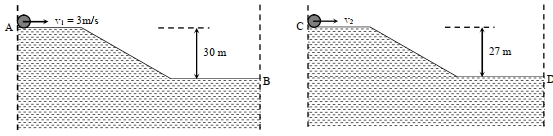
Two identical uniform discs roll without slipping on two different surfaces $AB$ and $CD$ (see figure) starting at $A$ and $C$ with linear speeds $v _1$ and $v _2$, respectively, and always remain in contact with the surfaces. If they reach $B$ and $D$ with the same linear speed and $v_1=3 \ m / s$, then $v_2$ in $m / s$ is $\left(g=10 \ m / s ^2\right)$
$Assertion$ : Radius of gyration of body is a constant quantity.
$Reason$ : The radius of gyration of a body about an axis of rotation may be defined as the root mean square distance of the particle from the axis of rotation
Two identical pendulums oscillate with a constant phase difference $\frac{\pi}{4}$ and same amplitude. If the maximum velocity of one is $v$, the maximum velocity of the other will be ........
$50$ tuning forks are arranged in increasing order of their frequencies such that each gives $4 \,beats/sec$ with its previous tuning fork. If the frequency of the last fork is octave of the first, then the frequency of the first tuning fork is  ... $Hz$
The layers of atmosphere are heated through
From a disc of radius $R$ and mass $M,$ a circular hole of diameter $R,$ whose rim passes through the centre is cut. What is the moment of inertia of the remaining part of the disc about a perpendicular axis, passing through the centre?
A load $W$ produces an extension of $1mm$ in a thread of radius $r.$ Now if the load is made $4W$ and radius is made $2r$ all other things remaining same, the extension will become..... $mm$