Potential at a point $x$-distance from the centre inside the conducting sphere of radius $R$ and charged with charge $Q$ is
Easy
Download our app for free and get started
(a) Potential at any point inside the charged spherical conductor equals to the potential at the surface of the conductor i.e. $Q/R$.

Download our appand get started for free
Experience the future of education. Simply download our apps or reach out to us for more information. Let's shape the future of learning together!No signup needed.*
Similar Questions
- 1A parallel plate capacitor is charged to a potential difference of $50\, V$. It is discharged through a resistance. After $1$ second, the potential difference between plates becomes $40 \,V$. ThenView Solution
- 2The electric potential at a point on the axis of an electric dipole depends on the distance $r$ of the point from the dipole asView Solution
- 3View SolutionIf a solid and a hollow conducting sphere have same radius then
- 4View SolutionA long, hollow conducting cylinder is kept coaxially inside another long, hollow conducting cylinder of larger radius. Both the cylinders are initially electrically neutral.
- 5During charging a capacitor variation of potential $V$ of the capacitor with time $t$ is shown asView Solution
- 6A parallel plate capacitor has plates with area $A$ and separation $d$ . A battery charges the plates to a potential difference $V_0$ . The battery is then disconnected and a dielectric slab of thickness $d$ is introduced. The ratio of energy stored in the capacitor before and after the slab is introduced, isView Solution
- 7The electric potential at a distance of $3 \,m$ on the axis of a short dipole of dipole moment $4 \times 10^{-12}$ coulomb-meter is ......... $mV$View Solution
- 8An electric dipole of moment $\vec p$ is lying along a uniform electric field $\vec E.$ The work done in rotating the dipole by $90^o $ isView Solution
- 9A charge is spread non-uniformly on the surface of a hollow sphere of radius $R$, such that the charge density is given by $\sigma=\sigma_0(1-\sin \theta)$, where $\theta$ is the usual polar angle. The potential at the centre of the sphere isView Solution
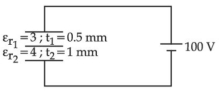
- 10A composite parallel plate capacitor is made up of two different dielectric materials with different thickness $\left(t_{1}\right.$ and $\left.t_{2}\right)$ as shown in figure. The two different dielectric material are separated by a conducting foil $F$. The voltage of the conducting foil is $.....V$View Solution