On moving a charge of $20$ coulombs by $2 \;cm , 2 \;J$ of work is done, then the potential difference between the points is (in $volt$)
AIEEE 2002, Easy


Download our appand get started for free
Experience the future of education. Simply download our apps or reach out to us for more information. Let's shape the future of learning together!No signup needed.*
Similar Questions
- 1Equipotential surfaces associated with an electric field which is increasing in magnitude along the $x$-direction areView Solution
- 2A small sphere of mass $m =\ 0.5\, kg$ carrying a positive charge $q = 110\ \mu C$ is connected with a light, flexible and inextensible string of length $r = 60 \ cm$ and whirled in a vertical circle. If a vertically upwards electric field of strength $E = 10^5 NC^{-1}$ exists in the space, The minimum velocity of sphere required at highest point so that it may just complete the circle........$m/s$ $(g = 10\, ms^{-2})$View Solution
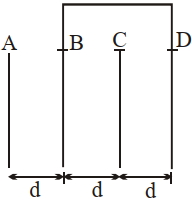
- 3Four identical rectangular plates with length, $l=2\, cm$ and breadth, $b =\frac{3}{2}\, cm$ are arranged as shown in figure. The equivalent capacitance between $A$ and $C$ is $\frac{ x \varepsilon_{0}}{ d } .$ The value of $x$ is (Round off to the Nearest Integer)View Solution
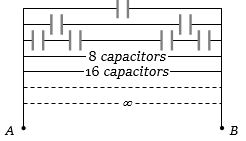
- 4An infinite number of identical capacitors each of capacitance $1\,\mu F$ are connected as in adjoining figure. Then the equivalent capacitance between $A$ and $B$ is......$\mu F$View Solution
- 5During charging a capacitor variation of potential $V$ of the capacitor with time $t$ is shown asView Solution
- 6View SolutionA parallel plate capacitor is connected to a battery and a dielectric slab is inserted between the plates, then which quantity increase
- 7A $16\ \Omega$ wire is bend to form a square loop. A $9 \mathrm{~V}$ battery with internal resistance $1\ \Omega$ is connected across one of its sides. If a $4\ \mu \mathrm{F}$ capacitor is connected across one of its diagonals, the energy stored by the capacitor will be $\frac{x}{2} \ \mu \mathrm{J}$. where $x=$________.View Solution
- 8A spherical metal shell $A$ of radius $R_A$ and a solid metal sphere $B$ of radius $R_B\left( < R_A\right)$ are kept far apart and each is given charge ' $+Q$ '. Now they are connected by a thin metal wire. ThenView Solution
$(A)$ $E_A^{\text {lnside }}=0$
$(B)$ $Q_A > Q_B$
$(C)$ $\frac{\sigma_A}{\sigma_B}=\frac{R_B}{R_A}$
$(D)$ $E_A^{\text {on sulface }} < E_B^{\text {on uurface }}$
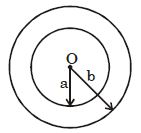
- 9If electric potential of the inner sphere is $10\, volt$ and that of the outer shell is $50\, volt$ then potential at common centre is :-......$V$View Solution
- 10The plates of a parallel plate condenser are pulled apart with a velocity $v$. If at any instant their mutual distance of separation is $d$, then the magnitude of the time of rate of change of capacity depends on $d$ as followsView Solution