Question
Two capacitors $C_1$ and $C_2$ are connected in a cirucit as shown in figure. The potential difference $(V_A -V_B)$ is.....$V$
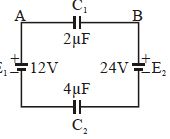
This potential difference is divided among two capacitors $\mathrm{C}_{1}$ and $\mathrm{C}_{2}$ in the inverse ratio of their capacities (as they are joined in series).
$\therefore \mathrm{V}_{1}=\frac{\mathrm{C}_{2}}{\mathrm{C}_{1}+\mathrm{C}_{2}} \mathrm{V}=\frac{4}{2+4} \times 12=8 \mathrm{\,volt}$
As plate of capacitor $\mathrm{C}_{1}$ towards point $\mathrm{B}$ will be at $+ \mathrm{ve}$ potential, hence
$\mathrm{V}_{\mathrm{B}}-\mathrm{V}_{\mathrm{A}}=8 \mathrm{\,volt}$ or $\quad \mathrm{V}_{\mathrm{A}}-\mathrm{V}_{\mathrm{B}}=-8 \mathrm{\,V}$
Generate a complete, print-ready paper with questions like this in minutes — across 16+ boards, with answer keys.
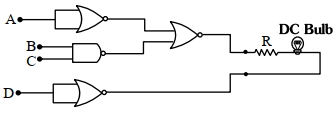
For which of the following combination, bulb will glow $(ON)$: