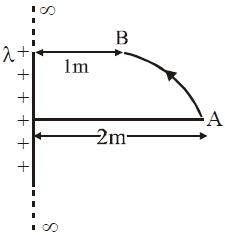
Figure shows a positively charged infinite wire. $A$ particle of charge $2C$ moves from point $A$ to $B$ with constant speed. (Given linear charge density on wire is $\lambda = 4 \pi \varepsilon_0$)
Medium


Download our appand get started for free
Experience the future of education. Simply download our apps or reach out to us for more information. Let's shape the future of learning together!No signup needed.*
Similar Questions
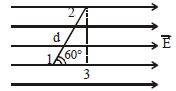
- 1The electric field $\vec E$ between two points is constant in both magnitude and direction. Consider a path of length d at an angle $\theta = 60^o$ with respect to field lines shown in figure. The potential difference between points $1$ and $2$ isView Solution
- 2The electric potential in a region is represented as $V = 2x + 3y -z$ ; then the expression of electric field strength isView Solution
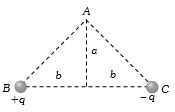
- 3As shown in the figure, charges $ + q$ and $ - q$ are placed at the vertices $B$ and $C$ of an isosceles triangle. The potential at the vertex $A$ isView Solution
- 4The figure shows a family of parallel equipotential surfaces and four paths along which an electron is made to move from one surface to another as shown in the figurView Solution
$(I)$ What is the direction of the electric field ?
$(II)$ Rank the paths according to magnitude of work done, greatest first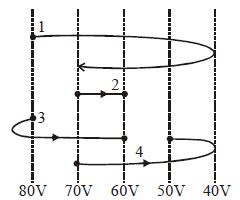
- 5View SolutionThe capacitance of a parallel plate condenser does not depend on
- 6In the following diagram, the charge and potential difference across $8\, \mu F$ capacitance will be respectivelyView Solution
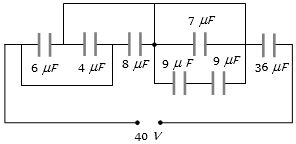
- 7Two charged parallel plate capacitors, each with separation between plates equal to $d$, are separated by a large distance $L >> d$. Then the force of interaction between them is proportional toView Solution
- 8A capacitor of $10\,\mu F$ charged up to $250\, volts$ is connected in parallel with another capacitor of $5\,\mu F$ charged up to $100\, volts$. The common potential is.....$V$View Solution
- 9A particle of mass $100\, gm$ and charge $2\, \mu C$ is released from a distance of $50\, cm$ from a fixed charge of $5\, \mu C$. Find the speed of the particle when its distance from the fixed charge becomes $3\, m$. Neglect any other force........$m/s$View Solution
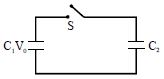
- 10A capacitor of capacity $C_1$ is charged to the potential of $V_0$. After disconnecting with the battery, it is connected with a neutral capacitor of capacity $C_2$ as shown in the adjoining figure. The ratio of energy of system before and after the connection of switch $S$ will beView Solution