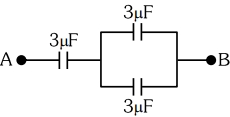
Two capacitors of $10\,\mu \,F$ and $20\,\mu \,F$ are connected in series with a $30\,V$ battery. The charge on the capacitors will be, respectively
Medium


Download our appand get started for free
Experience the future of education. Simply download our apps or reach out to us for more information. Let's shape the future of learning together!No signup needed.*
Similar Questions
- 1Three capacitors $2$ $\mu F$, $3$ $\mu F$ and $5$ $\mu F$ can withstand voltages to $3\,V, 2\,V$ and $1\,V$ respectively. Their series combination can withstand a maximum voltage equal to.....$Volts$View Solution
- 2An arc of radius $r$ carries charge. The linear density of charge is $\lambda$ and the arc subtends a angle $\frac{\pi }{3}$ at the centre. What is electric potential at the centreView Solution
- 3A $12\,pF$ capacitor is connected to a $50\,V$ battery. How much electrostatic energy is stored in the capacitorView Solution
- 4Sixty-four drops are jointed together to form a bigger drop. If each small drop has a capacitance $C$, a potential $V$, and a charge $q$, then the capacitance of the bigger drop will beView Solution
- 5A parallel plate capacitor of capacitance $C$ is connected to a battery and is charged to a potential difference $V$. Another capacitor of capacitance $2C$ is similarly charged to a potential difference $2V$. The charging battery is now disconnected and the capacitors are connect in parallel to each other in such a way that the positive terminal of one is connected to the negative terminal of the other. The final energy of the configuration isView Solution
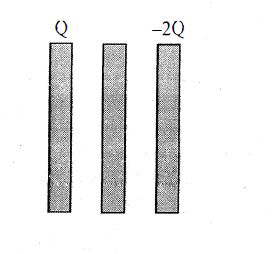
- 6The identical metal plates with large surface areas are kept parallel to each other as shown in figure. The left most plate is given a charge $Q$ , the rightmost a charge $-2Q$ and the middle one remains neutral. Find the charge appearing on the outer surface of the rightmost plateView Solution
- 7A spherical drop of mercury having a potential of $2.5\, V$ is obtained as a result of merging $125$ droplets. The potential of constituent droplets would be........$V$View Solution
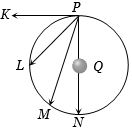
- 8In the figure the charge $Q$ is at the centre of the circle. Work done is maximum when another charge is taken from point $P$ toView Solution
- 9View SolutionA battery is used to charge a parallel plate capacitor till the potential difference between the plates becomes equal to the electromotive force of the battery. The ratio of the energy stored in the capacitor and the work done by the battery will be
- 10The equivalent capacitance of the system shown in the following circuit is $...........\mu F$View Solution