If a charge is shifted from a low potential region to high potential region, the electric potential energy
Easy


Download our appand get started for free
Experience the future of education. Simply download our apps or reach out to us for more information. Let's shape the future of learning together!No signup needed.*
Similar Questions
- 1View SolutionSome charge is being given to a conductor. Then its potential is
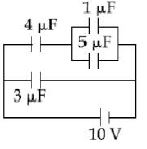
- 2In the given circuit, the charge on $4\, \mu F$ capacitor will be.....$\mu C$View Solution
- 3Four charges $2C, -3C, -4C$ and $5C$ respectively are placed at all the corners of a square. Which of the following statements is true for the point of intersection of the diagonals ?View Solution
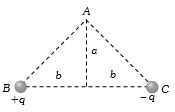
- 4As shown in the figure, charges $ + q$ and $ - q$ are placed at the vertices $B$ and $C$ of an isosceles triangle. The potential at the vertex $A$ isView Solution
- 5If $50$ joule of work must be done to move an electric charge of $2 \,C$ from a point, where potential is $-10$ volt to another point, where potential is $V$ volt, the value of $V$ is ......... $V$View Solution
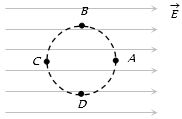
- 6The electric field in a region surrounding the origin is uniform and along the $x$ - axis. A small circle is drawn with the centre at the origin cutting the axes at points $A, B, C, D$ having co-ordinates $(a, 0), (0, a), (-a, 0), (0, -a)$; respectively as shown in figure then potential in minimum at the pointView Solution
- 7A particle of charge $Q$ and mass $M$ moves in a circular path of radius $R$ in a uniform magnetic field of magnitude $B$. The same particle now moves with the same speed in a circular path of same radius $R$ in the space between the cylindrical electrodes of the cylindrical capacitor. The radius of the inner electrode is $R/2$ while that of the outer electrode is $ 3R/2.$ Then the potential difference between the capacitor electrodes must beView Solution
- 8View SolutionAdielectric slab is inserted between the plates of an isolated charged capacitor. Which of the following quantities will remain the same?
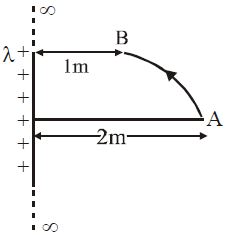
- 9Figure shows a positively charged infinite wire. $A$ particle of charge $2C$ moves from point $A$ to $B$ with constant speed. (Given linear charge density on wire is $\lambda = 4 \pi \varepsilon_0$)View Solution
- 10A parallel plate capacitor is made by stacking $n$ equally spaced plates connected alternately. If the capacitance between any two plates is $C$ then the resultant capacitance isView Solution