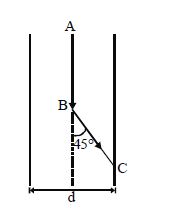
A sphere carrying charge of $Q$ having weight $w$ falls under gravity between a pair of vertical plates at a distance of $d$ from each other. When a potential difference $V$ is applied between the plates the acceleration of sphere changes as shown in the figure, to along line $BC$. The value of $Q$ is :-
Medium
Download our app for free and get started
$\tan 45^{\circ}=\frac{q E}{m g} \Rightarrow w=\frac{V}{d} q \Rightarrow q=\frac{w d}{V}$

Download our appand get started for free
Experience the future of education. Simply download our apps or reach out to us for more information. Let's shape the future of learning together!No signup needed.*
Similar Questions
- 1Capacitance of an isolated conducting sphere of radius $R_{1}$ becomes $n$ times when it is enclosed by a concentric conducting sphere of radius $R_{2}$ connected to earth. The ratio of their radii $\left(\frac{ R _{2}}{ R _{1}}\right)$ is:View Solution
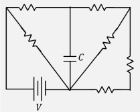
- 2View SolutionConsider the circuit shown in the figure below. All the resistors are identical. The charge stored in the capacitor, once it is fully charged is
- 3In a parallel plate condenser, the radius of each circular plate is $12\,cm$ and the distance between the plates is $5\,mm$. There is a glass slab of $3\,mm$ thick and of radius $12\,cm$ with dielectric constant $6$ between its plates. The capacity of the condenser will beView Solution
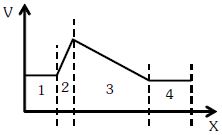
- 4In which region magnitude of $x$ -component of electric field is maximum, if potential $(V)$ versus distance $(X)$, graph is as shown?View Solution
- 5Twenty seven drops of same size are charged at $220\, \mathrm{~V}$ each. They combine to form a bigger drop. Calculate the potential of the bigger drop. (In $\mathrm{~V}$)View Solution
- 6The capacity of a condenser is $4 \times {10^{ - 6}}$ farad and its potential is $100\,\,volts$. The energy released on discharging it fully will be.......$Joule$View Solution
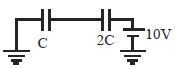
- 7In the circuit shown in the figure, $C = 6\,\mu F$. The charge stored in the capacitor of capacity $C$ is......$\mu C$View Solution
- 8Uniform electric field of magnitude $100$ $V/m$ in space is directed along the line $y = 3 + x$. Find the potential difference between point $A$ $ (3, 1)$ $\&$ $B$ $(1, 3)$.......$V$View Solution
- 9$A, B$ and $C$ are three points in a uniform electric field. The electric potential isView Solution
- 10A parallel plate capacitor with plates of area $1\,m^2$ each, are at a separation of $0.1\,m.$ If the electric field between the plates is $100\,N/C,$ the magnitude of charge on each plateView Solution