Question
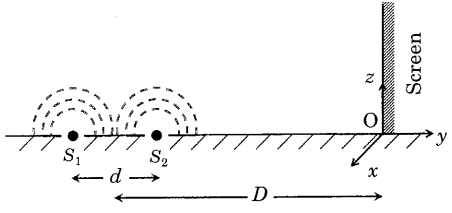
While conducting the Young's double slit experiment, a student replaced the two slits with a large opaque plate in the $x-y$ plane containing two small holes that act as two coherent point sources $\left(S_1, S_2\right)$ emitting light of wavelength $600 \mathrm{~nm}$. The student mistakenly placed the screen parallel to the $x-z$ plane (for $z>0$ ) at a distance $D=3 \mathrm{~m}$ from the mid-point of $S_1 S_2$, as shown schematically in the figure. The distance between the sources $d=0.6003 \mathrm{~mm}$. The origin $\mathrm{O}$ is at the intersection of the screen and the line joining $S_1 S_2$. Which of the following is(are) true of the intensity pattern on the screen?

($A$) Straight bright and dark bands parallel to the $x$-axis

($B$) The region very close to the point $O$ will be dark

($C$) Hyperbolic bright and dark bands with foci symmetrically placed about $\mathrm{O}$ in the $x$-direction

($D$) Semi circular bright and dark bands centered at point $\mathrm{O}$
Answer

$(B)$ Seml clrcular bright and dark bands centred at polnt $O$

$(C)$ The reglon very close to the polnt $O$ will be dark

Since $S _1 S_2$ line is perpendicular to screen shape of pattern is concentric semicircle

$\text { At } O , \frac{2 \pi}{\lambda}\left( S _1 O - S _2 O \right)$

$=\frac{2 \pi \times 0.6003 \times 10^{-3}}{600 \times 10^{-9}}=2001 \pi$

$\therefore$ darkness close to $O$ .

Need a full question paper?

Generate a complete, print-ready paper with questions like this in minutes — across 16+ boards, with answer keys.

Start Generating Free

Similar questions

A light rope is wound around a hollow cylinder of mass $5\,kg$ and radius $70\,cm$. The rope is pulled with a force of $52.5\,N$. The angular acceleration of the cylinder will be.....$ {rad \,s}{ }^{-2}$.
A block is placed on a frictionless horizontal table. The mass of the block is m and springs are attached on either side with force constants ${K_1}$ and ${K_2}$. If the block is displaced a little and left to oscillate, then the angular frequency of oscillation will be
A body takes just twice the time as long to slide down a plane inclined at $30^o$ to the horizontal as if the plane were frictionless. The coefficient of friction between the body and the plane is
The moment of inertia of a body about a given axis is $2.4\ kg-m^2$.  To produce a rotational kinetic energy of $750\ J$, an angular acceleration of $5\ rad/s^2$ must be applied about that axis for.......... $\sec$
A force $F=\left(5+3 y^2\right)$ acts on a particle in the $y$ direction, where $F$ is newton and $y$ is in meter. The work done by the force during a displacement from $y =2\,m$ to $y =5\,m$ is $.............\,j$.
In a single slit diffraction experiment first minimum for red light ($ \gamma =  660\, nm$) coincides with first maximum of some other wavelength $\lambda$'. The value of $\lambda$' is......$\mathop A\limits^o $
Consider the following statements ( $X$ and $Y$ stand for two different elements):

$(I)$ ${ }_{32}^{65} X$ and ${ }_{33}^{65} Y$ are isotopes.

$(II)$ ${ }_{42}^{86} X$ and ${ }_{42}^{85} Y$ are isotopes.

$(III)$ ${ }_{85}^{174} X$ and ${ }_{88}^{177} Y$ have the same number of neutrons.

$(IV)$ ${ }_{92}^{235} X$ and ${ }_{94}^{235} Y$ are isobars.

Which of the above statements are correct?

$Assertion$ : Specific gravity of a fluid is a dimensionless quantity.

$Reason$ : It is the ratio of density of fluid to the density of water

An electric dipole is placed at an angle of $60^{\circ}$ with an electric field of intensity $1 \times 10^5 NC ^{-1}$. It experiences a torque equal to 5 Nm. Calculate the magnitude of charge on the dipole, if the dipole length is 2 cm
Starting from rest, a body slides down a $45^°$ inclined plane in twice the time it takes to slide down the same distance in the absence of friction. The coefficient of friction between the body and the inclined plane is