MCQ
Given below are two statements: one is labelled as Assertion $A$ and the other is labelled as

Reason $R$.

Assertion $A :$ An electron microscope can achieve better resolving power than an optical microscope.

Reason $R$ : The de Broglie's wavelength of the electrons emitted from an electron gun is much less than wavelength of visible light.

In the light of the above statements, choose the correct answer from the options given below

  • A
    $A$ is true but $R$ is false.
  • Both $A$ and $R$ are true and $R$ is the correct explanation of $A$.
  • C
    Both $A$ and $R$ are true but $R$ is $N O T$ the correct explanation of $A$.
  • D
    $A$ is false but $R$ is true.

Answer

Correct option: B.
Both $A$ and $R$ are true and $R$ is the correct explanation of $A$.
b
Resolving power $\propto \frac{1}{\lambda}$

Since wavelength of electron is much less than visible light, its resolving power will be much more.

Need a full question paper?

Generate a complete, print-ready paper with questions like this in minutes — across 16+ boards, with answer keys.

Start Generating Free

Similar questions

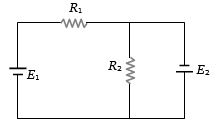
Two resistances ${R_1}$ and ${R_2}$ are joined as shown in the figure to two batteries of $e.m.f.$ ${E_1}$ and ${E_2}$. If ${E_2}$ is short-circuited, the current through ${R_1}$ is
Which of the following statement is correct
Which of the following is not a consequence of Gauss’s law?
Two capacitors each of 1μF capacitance are connected in parallel and are then charged by 200 volts d.c. supply. The total energy of their charges (in joules) is
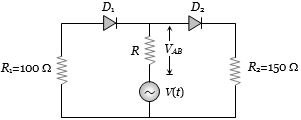
In the circuit given below, $V(t) $ is the sinusoidal voltage source, voltage drop $V_{AB}(t) $ across the resistance $R$  is
If an insulated non-conducting sphere of radius R has charge density ρ. The electric field at a distance r from the centre of sphere (r < R) will be
 
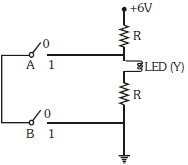
The correct Boolean operation represented by the circuit diagram drawn is
Back isotopes of hydrogen has $........$ proton. Fill in the blank.
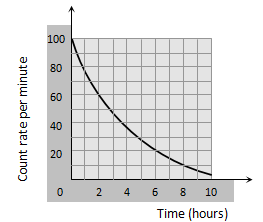
The count rate of 10g of radioactive material was measured at different times and this has been shown in the figure. The half life of material and the total counts (approximately) in the first half life period, respectively are
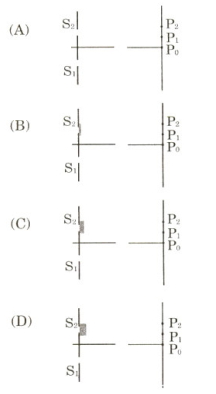
Column $I$ shows four situations of standard Young's double slit arrangement with the screen placed far away from the slits $S_1$ and $S_2$. In each of these cases $\mathrm{S}_1 \mathrm{P}_0=\mathrm{S}_2 \mathrm{P}_0, \mathrm{~S}_1 \mathrm{P}_1-\mathrm{S}_2 \mathrm{P}_1=\lambda / 4$ and $\mathrm{S}_1 \mathrm{P}_2-\mathrm{S}_2 \mathrm{P}_2=\lambda / 3$, where $\lambda$ is the wavelength of the light used. In the cases $\mathrm{B}, \mathrm{C}$ and $\mathrm{D}$, a transparent sheet of refractive index $\mu$ and thickness $t$ is pasted on slit $\mathrm{S}_2$. The thicknesses of the sheets are different in different cases. The phase difference between the light waves reaching a point $\mathrm{P}$ on the screen from the two slits is denoted by $\delta(\mathrm{P})$ and the intensity by $I(\mathrm{P})$. Match each situation given in Column $I$ with the statement$(s)$ in Column $II$ valid for that situation.

Column $I$ Column $II$
$(A)$ $Image$ $(p)$ $\delta\left(\mathrm{P}_0\right)=0$
$(B)$ $(\mu-1) t=\lambda / 4$ $Image$ $(q)$ $\delta\left(\mathrm{P}_1\right)=0$

$(C)$ $(\mu-1) t=\lambda / 2$ $Image$

$(r)$ $I\left(\mathrm{P}_1\right)=0$
$(D)$ $(\mu-1) t=3 \lambda / 4$ $Image$ $(s)$ $\left(\mathrm{P}_0\right)>I\left(\mathrm{P}_1\right)$
  $(t)$ $I\left(\mathrm{P}_2\right)>I\left(\mathrm{P}_1\right)$