MCQ
Two charged particles traverse identical helical paths in a completely opposite sense in a uniform magnetic field $B = B_0 \hat k$ .
  • A
    They have equal $z-$ components of momenta
  • B
    They must have equal charges
  • C
    They necessarily represent a particle, antiparticle pair
  • The chrge to mass ratio satisfy ${\left( {\frac{e}{m}} \right)_1} + {\left( {\frac{e}{m}} \right)_2} = 0$
Answer

Correct option: D.
The chrge to mass ratio satisfy ${\left( {\frac{e}{m}} \right)_1} + {\left( {\frac{e}{m}} \right)_2} = 0$
d
For given pitch, $d$ corresponds to charged particle, we have

$\frac{\mathrm{q}}{\mathrm{m}}=\frac{2 \pi \mathrm{v} \cos \theta}{\mathrm{B}}=\mathrm{constant} \Rightarrow\left(\frac{\mathrm{e}}{\mathrm{m}}\right)_{1}+\left(\frac{\mathrm{e}}{\mathrm{m}}\right)_{2}=0$

Note Consider $e$ in place of $\mathrm{q}$ in solution.

Need a full question paper?

Generate a complete, print-ready paper with questions like this in minutes — across 16+ boards, with answer keys.

Start Generating Free

Similar questions

When the temperature of a magnetic material decreases, the magnetization.
A free neutron decays to a proton but a free proton does not decay to a neutron. This is because:
Carbon dating is best suited for determining the age of fossils if their age in years is of the order of
The photoelectric threshold wavelength for a metal surface is 6600 Å. The work function for this is
When a $DC$ voltage of $200\, V$ is applied to a coil of self inductance $\frac{{2\sqrt 3 }}{\pi }\,H$, a current of $1\, A$ flows through it. But by replacing $DC$ source with $AC$ source of $200\, V$, the current in the coil is reduced to $0.5\, A$. Then, the frequency of $AC$ supply is......$Hz$
Mark the incorrect statement.
In case Hall effect for a strip having charge $Q$ and area of cross-section $A$, the Lorentz force is
The susceptibility of a paramagnetic material is $99$ . The permeability of the material in $Wb / A - m$ is : [Permeability of free space $\left.\mu_{0}=4 \pi \times 10^{-7} Wb / A -m\right]$
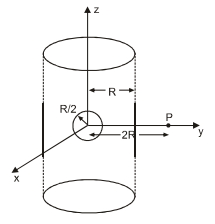
An infinitely long solid cylinder of radius $R$ has a uniform volume charge density $\rho$. It has a spherical cavity of radius $R / 2$ with its centre on the axis of the cylinder, as shown in the figure. The magnitude of the electric field at the point $P$, which is at a distance $2 \ R$ from the axis of the cylinder, is given by the expression $\frac{23 \rho R }{16 k \varepsilon_0}$. The value of $k$ is
A double convex thin lens made of glass of refractive index 1.6 has radii of curvature 15 cm each. The focal length of this lens when immersed in a liquid of refractive index 1.63 is