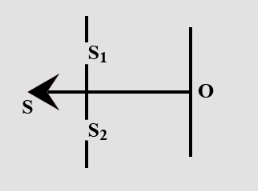
- The charge to mass ratio satisfy: $\Big(\frac{\text{e}}{\text{m}}\Big)_1+\Big(\frac{\text{e}}{\text{m}}\Big)_2=0$.
Solution:
Key concept: In this situation if the particle is thrown in x-y plane (as shown in figure) at some angle θ with velocity v, then we have to resolve the velocity of the particle in rectangular components, such that one component is along the field (v cosθ) and other one is perpendicular to the field (v sinθ). We find that the particle moves with constant velocity v cosθ along the field. The distance covered by the particle along the magnetic field is called pitch.
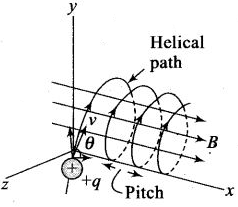
The pitch of the helix, (i.e., linear distance travelled in one rotation) will be given by
$\text{p}=\text{T}(\text{v}\cos\theta)=2\text{p}\frac{\text{m}}{\text{qB}}(\text{v}\cos\theta)$
For given pitch p correspond to charge particle, we have
$\frac{\text{q}}{\text{m}}=\frac{2\pi\text{v}\cos\theta}{\text{qB}}=\text{constant}$
Here in this case, charged particles traverse identical helical paths in a completely opposite sense in a uniform magnetic field B, LHS for two particles should be same and of opposite sign. Therefore,
$\Big(\frac{\text{e}}{\text{m}}\Big)_1+\Big(\frac{\text{e}}{\text{m}}\Big)_2=0$