Two charged spheres of radii $10\, cm$ and $15\, cm$ are connected by a thin wire. No current will flow, if they have
Easy
Download our app for free and get started
(b) Because current flows from higher potential to lower potential.

Download our appand get started for free
Experience the future of education. Simply download our apps or reach out to us for more information. Let's shape the future of learning together!No signup needed.*
Similar Questions
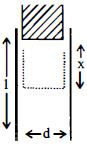
- 1A parallel plate capacitor is made of two plates of length $l$, width $w$ and separated by distance $d$. A dielectric slab ( dielectric constant $K$) that fits exactly between the plates is held near the edge of the plates. It is pulled into the capacitor by a force $F = -\frac{{\partial U}}{{\partial x}}$ where $U$ is the energy of the capacitor when dielectric is inside the capacitor up to distance $x$ (See figure). If the charge on the capacitor is $Q$ then the force on the dielectric when it is near the edge isView Solution
- 2View SolutionState which of the following is correct
- 3Two metal spheres, one of radus $R$ and the other of radius $2 R$ respectively have the same surface charge density $\sigma$. They are brought in contact and separated. What will be the new surface charge densities on them?View Solution
- 4The distance between two plates of a capacitor is $d$ and its capacitance is $C _1$, when air is the medium between the plates. If a metal sheet of thickness $\frac{2 d }{3}$ and of same area as plate is introduced between the plates, the capacitance of the capacitor becomes $C _2$. The ratio $\frac{ C _2}{ C _1}$ is:View Solution
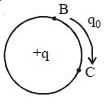
- 5A circle of radius $R$ is drawn with charge $+ q$ at the centre. A charge $q_0$ is brought from point $B$ to $C$, then work done isView Solution
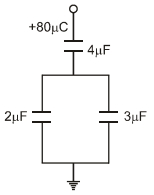
- 6In the given circuit, a charge of $+80 \ \mu C$ is given to the upper plate of the $4 \ \mu F$ capacitor. Then in the steady state, the charge on the upper plate of the $3 \ \mu F$ capacitor is :View Solution
- 7An uncharged parallel plate capacitor having a dielectric of constant $K$ is connected to a similar air-cored parallel capacitor charged to a potential $V$. The two share the charge and the common potential is $V'$. The dielectric constant $K$ isView Solution
- 8Two identical positive charges are placed at $x =\, -a$ and $x = a$ . The correct variation of potential $V$ along the $x-$ axis is given byView Solution
- 9Combination of two identical capacitors, a resistor $R$ and a $DC$ voltage source of voltage $6\; V$ is used in an experiment on $C-R$ circuit. It is found that for a parallel combination of the capacitor the time in which the voltage of the fully charged combination reduces to half its original voltage is $10\; s$. For series combination the time needed for reducing the voltage of the fully charged series combination by half isView Solution
- 10Three concentric conducting spherical shells have radius $ r, 2r$ and $3r$ and $Q_1, Q_2$ and $Q_3$ are final charges respectively. Innermost and outermost shells are already earthed as shown in figure. Choose the wrong statement.View Solution
