The potential at a distance $R/2$ from the centre of a conducting sphere of radius $ R$ will be
Easy


Download our appand get started for free
Experience the future of education. Simply download our apps or reach out to us for more information. Let's shape the future of learning together!No signup needed.*
Similar Questions
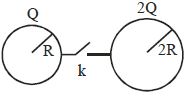
- 1Two spheres of radius $R$ and $2R$ having charge $Q$ and $2Q$ respectively are placed far away from each other. How much charge will flow when key $'k'$ is pressed ?View Solution
- 2The distance between the circular plates of a parallel plate condenser $40\,mm$ in diameter, in order to have same capacity as a sphere of radius $1\;metre$ is....$mm$View Solution
- 3View SolutionA conductor with a positive charge
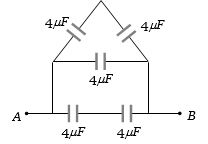
- 4Equivalent capacitance between $A$ and $B$ is......$\mu \,F$View Solution
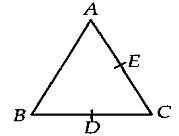
- 5Three charges, each $+q,$ are placed at the comers of an isosceles triangle $ABC$ of sides $BC$ and $AC, 2a.$ $D$ and $E$ are the mid-points of $BC$ and $CA.$ The work done in taking a charge $Q$ from $D$ to $E$ isView Solution
- 6Two parallel large thin metal sheets have equal surface charge densities $\left(\sigma=26.4 \times 10^{-12} C / m ^{2}\right)$ of same signs. The electric field between these sheet isView Solution
- 7Two capacitors of capacitances $1\ \mu F$ and $3\ \mu F$ are charged to the same voltages $5\,V$. They are connected in parallel with oppositely charged plates connected together. Then:View Solution
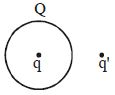
- 8A thin metallic spherical shell contains a charge $Q$ on it. A point charge $+q$ is placed at the centre of the shell and another charge $q'$ is placed outside it as shown in fig. All the three charges are positive. The force on the central charge due to the shell is :-View Solution
- 9The electric field between the two parallel plates of a capacitor of $1.5 \mu \mathrm{F}$ capacitance drops to one third of its initial value in $6.6 \mu \mathrm{s}$ when the plates are connected by a thin wire. The resistance of this wire is. . . . . . . .$\Omega$. (Given, $\log 3=1.1)$View Solution
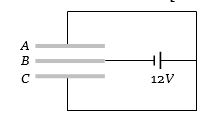
- 10Three plates $A,\;B,\;C$each of area $50\,c{m^2}$ have separation $3\,mm$ between $A$ and $B$ and $3\,mm$ between $B$ and $C$. The energy stored when the plates are fully charged isView Solution